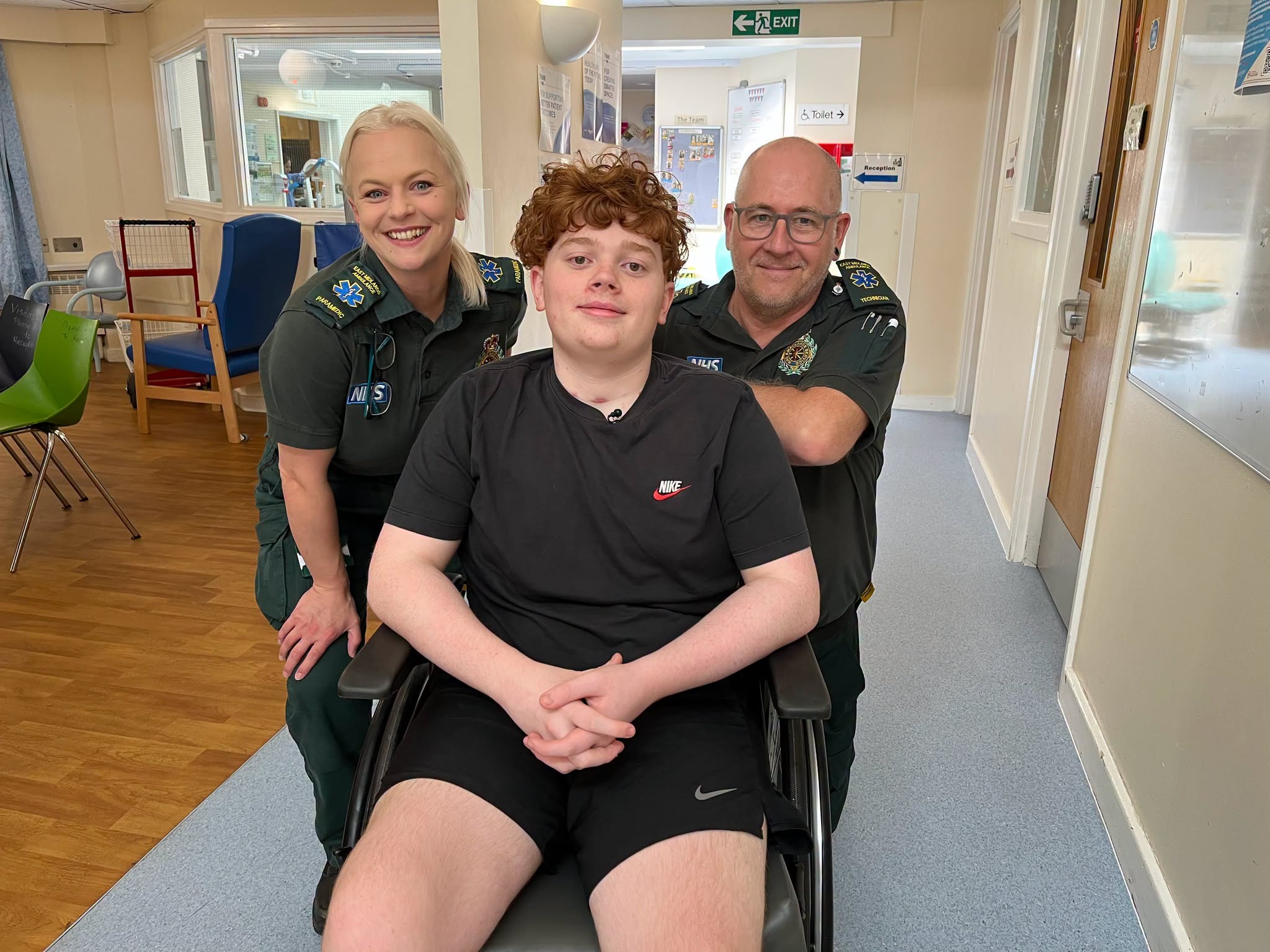
A 17-year-old who suffered a cardiac arrest at home has been reunited with some of the East Midlands Ambulance Service team who helped save his life.
Flynn Young met emergency medical adviser Courtney Jones, ambulance technician Darren Walker and paramedic Jessica Czykita at Linden Lodge Neurorehabilitation Unit at Nottingham City Hospital on Thursday 6 August 2026.


Although not everyone involved in Flynn’s care could attend, the reunion provided an opportunity to reflect on the wider team effort behind his recovery.
The 999 call
Four months earlier, during the early hours of Thursday 2 April 2026, Flynn was asleep at home when he fell out of bed, waking his mum, Melanie Young.
When she went to investigate, she found Flynn on the floor, unresponsive and gasping for breath. Believing he might be having a seizure, she attempted to place him in the recovery position before calling 999.
The call was answered by emergency medical adviser Courtney Jones, who quickly established that Flynn was not breathing normally and instructed Melanie to begin cardiopulmonary resuscitation.

Melanie said: “When Courtney asked whether Flynn’s chest was moving up and down, I looked and realised it wasn’t.
“Everything suddenly became very real. One minute I was trying to work out what was wrong with Flynn and the next I was being told I needed to start CPR on my own son.
“It was every parent’s worst nightmare, but Courtney stayed calm throughout and kept encouraging me to carry on.
“In that moment, I didn’t feel like I was doing it on my own.”
Emergency response
As Melanie continued CPR under Courtney’s guidance, resources from East Midlands Ambulance Service and The Air Ambulance Service were dispatched to the scene.
Jessica and Darren were among the ambulance crew members who attended. They immediately continued CPR while attaching a defibrillator.
Melanie said: “Jessica was sweating and really putting her back into the chest compressions. She kept talking to Flynn, saying ‘come on, sweetheart’, and she never gave up.
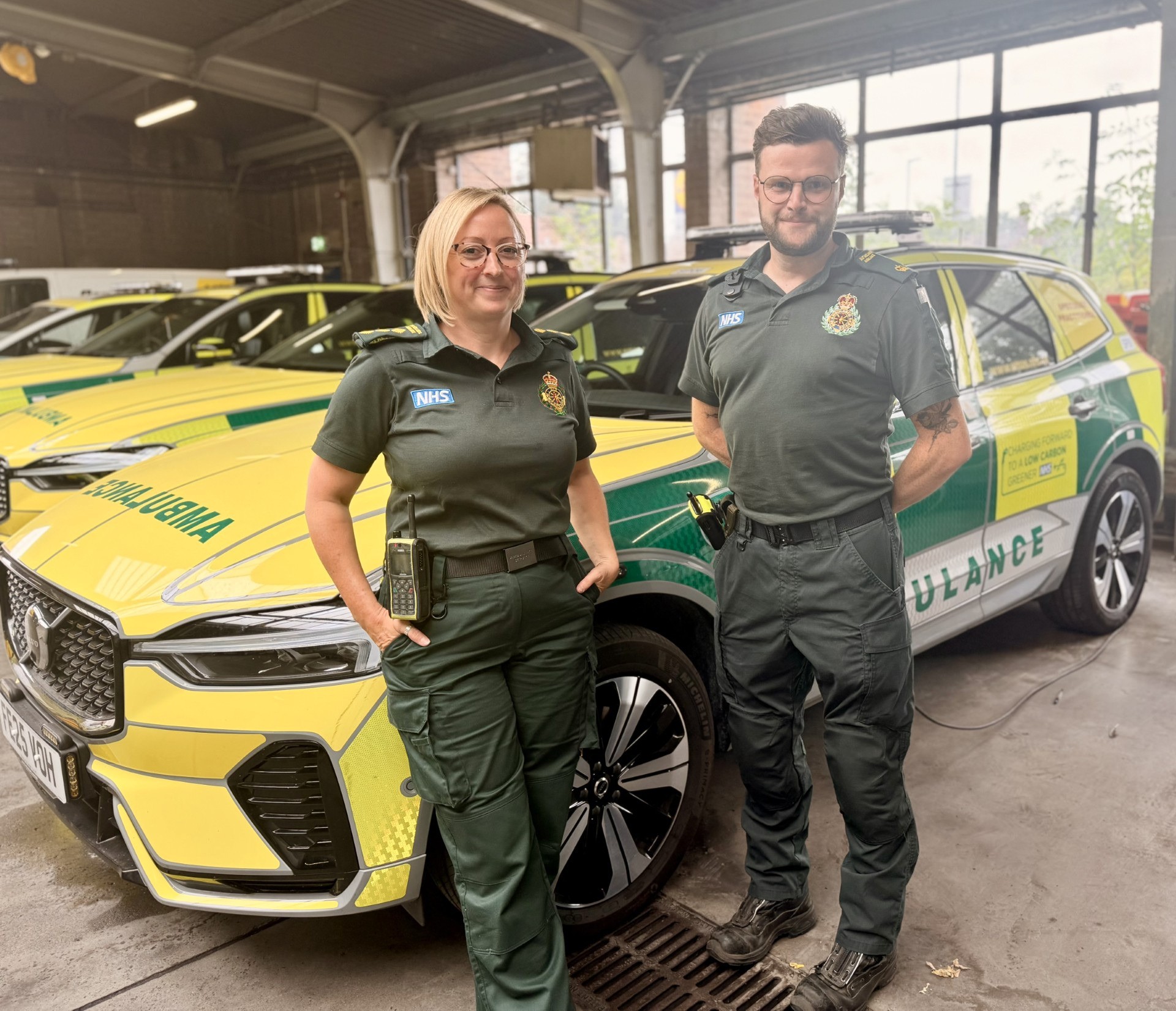
“She spoke to him like he was her own son.”
Darren identified that Flynn was in a shockable heart rhythm, allowing the crew to deliver lifesaving shocks from the defibrillator.
Additional colleagues from EMAS, The Air Ambulance Service and Nottinghamshire Police soon arrived, working together to continue Flynn’s treatment and transport him safely to hospital.
Jessica said: “The bedroom was quite cramped, and Flynn is a tall lad, so it took a real team effort to keep treating him while also working out how to move him safely.
“The police officers who attended were a massive help and, as more EMAS and air ambulance colleagues arrived, everybody worked together towards the same goal.
“My own son is a similar age to Flynn, so this response has always stayed with me.”
EMAS colleagues Nicola Stewart and Jamie Hahn were also among those who attended.
Nicola, who was the duty commander at the scene that morning, said: “I want to pay tribute to the seamless way all the resources on scene worked together – combining their skills to deliver immediate, high-quality resuscitation that gave Flynn the best possible chance of recovery.
“I’m extremely happy Flynn continues to make progress in hospital, an exceptional outcome for a young patient in the most serious of circumstances.”
Andy Mackintosh, trainee critical care paramedic at The Air Ambulance Service, said: “Our service was able to bring specialist clinicians to Flynn’s home to begin treatment that would normally only be available in the Emergency Department.
“Once his heart had been restarted, further treatment could begin immediately to help stabilise his condition and support his recovery.”
Recovery
Although Flynn’s heart was restarted, his condition remained critical.
He was admitted to intensive care, where doctors warned his family that he might not survive and that, if he did, he could be left with significant long-term effects.
Melanie said: “For a time, he was one of the most poorly patients on intensive care and we were being prepared for a future where he might never regain his sight, his memory, or his independence.
“To go from those conversations to where we are today feels incredible.
“He’s still as cheeky as ever, he’s talking about the future, and he’s proving people wrong every day. We never take that for granted.”
Before his cardiac arrest, Flynn was studying biology, psychology and English literature at sixth form.
He is now undergoing specialist rehabilitation and working towards returning to his studies, spending time with friends and regaining his independence.
Flynn said: “When people explained everything that had happened, it was difficult to take in.
“But the more I learned about what everyone had done for me, the more grateful I felt. I know how fortunate I am to be here.
“I’ve been helped by so many healthcare professionals throughout my recovery that it’s made me think about helping other people in the future. I’d like to become a physiotherapist or occupational therapist.
“Right now, I’m looking forward to continuing my recovery, getting back to sixth form, seeing my friends more often and returning to normality.”
Specialist practitioner Jamie Hahn, who was part of the EMAS response in April, said: “Flynn’s story shows how effective collaborative working between EMAS and our air ambulance colleagues can maximise the chances of survival following a sudden cardiac arrest.
“However, the chain of survival depends on early recognition, prompt chest compressions, and clear communication from bystanders.
“On that morning, Flynn’s mum was the first vital link in that chain. Her actions were brave, effective and admirable in the most traumatic of circumstances.
“It is incredibly inspiring to hear of the progress Flynn has made since that challenging morning for everyone involved.”
The reunion
For Courtney, the reunion provided a rare opportunity to meet a patient whose call had stayed with her long after her shift ended.
She said: “I’ve answered a lot of cardiac arrest calls involving people of all ages, but not many involving someone so young.
“You don’t usually get to find out what happens after the call ends.
“To see Flynn making such good progress and to meet him and his family in person has been really special.”
Melanie believes her previous CPR training and the support she received over the phone helped her act when Flynn needed her most.
She said: “People have asked whether I was worried about hurting Flynn, but his heart had stopped. The worst had already happened.
“Having some CPR training gave me the confidence to start, but Courtney kept me going until the ambulance crew arrived.
“If I hadn’t picked up that phone and called 999, Flynn wouldn’t be here today.
“Everyone involved, from Courtney answering the phone through to the EMAS and air ambulance response, and the hospital staff, helped save my son’s life.”
