
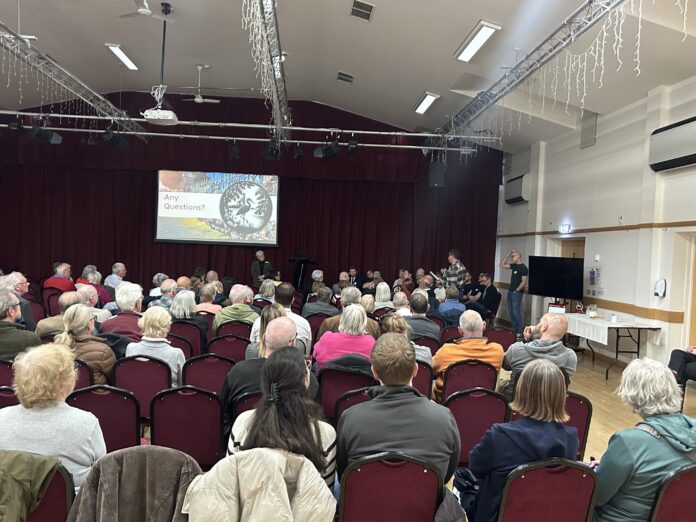
More than 100 residents attended a public meeting in Radcliffe-on-Trent on Wednesday evening to question parish councillors over a 180 per cent increase in the local council tax precept.
The meeting, held at Grange Hall, was the first opportunity for many residents to raise concerns directly with the parish council since the increase was announced in December and came into effect at the start of the financial year in April.
A Band D household in the parish now pays £312 to the parish council as part of its overall council tax bill.
During the public question session, residents raised concerns about the scale of the increase and how the decision had been made.
Councillor Mills said: “Nobody wanted to increase the precept to this level. However sometimes the hard decisions are the right ones.”
He said the previous year’s budget had assumed more than £350,000 in grant funding, but applications for those grants had not been submitted. As a result, the council faced a potential overspend of around £375,000 without intervention.


He added that non-essential spending had been halted in mid-2025 in response to the financial position.
Responding to questions about how the council had managed in previous years, Mr Pope referred to the condition of some council-owned assets, which he said were in a deteriorated state and required investment.
- Why Radcliffe on Trent’s parish council tax is rising by over 180% – and what it means for residents
Residents also questioned how the parish compared with similar-sized areas such as Cotgrave and East Leake, where Band D households are expected to pay £117 and £88 respectively in 2026/27.
Councillor Mills said direct comparisons were difficult due to differences in assets, housing numbers, staffing and services. A resident responded: “I accept they are different but they are not that different. They certainly don’t justify this increase.”
Questions were also raised about the council’s asset register, which estimates the value of parish-owned assets at around £6 million. Some residents queried the inclusion and valuation of certain items.
Mr Pope said the register was still being developed and would be updated over time. Councillor Mills added that it was based on assumptions and acknowledged it was “not infallible”.
Residents also asked why the council had not applied for grant funding after identifying the shortfall. Councillor Mills said: “We haven’t had the time,” adding that grant funding is not guaranteed and often requires matched funding, which the council did not have available.
Mr Pope said the council would look at grant opportunities in future.
Some residents expressed support for the council and the town. One attendee said comparisons with other areas were not appropriate, while another noted that parish councillors are unpaid and also pay council tax themselves.
However, others remained critical. One resident described the increase as “totally unfair”, while another questioned whether there was a plan to reduce the precept in future.
Councillor Mills said the council was not currently in a position to significantly reduce the precept, adding that previous levels had been unsustainable.
He said: “We’re looking forward and we’re trying our best here to set a new direction for this council, where we’re not scrambling to fix something when it breaks or gets vandalised – one where we actually have funds to be able to maintain things, fix things and do things proactively rather than reactively.”
He added that improving engagement with residents would be a priority over the coming year.
Mr Pope said the council’s aim was to support the long-term sustainability of the parish, adding that councillors were committed to the community and its future.
