
Nottingham Forest has submitted a fresh set of planning applications that would reshape the City Ground and take the historic riverside stadium to a capacity of up to 52,500, replacing and superseding earlier expansion proposals that had centred on a more limited redevelopment of the Peter Taylor Stand.
The latest submission represents the most comprehensive plan yet for the long-term future of Forest’s home, setting out a phased redevelopment of three sides of the ground alongside extensive public realm works on the south bank of the River Trent.


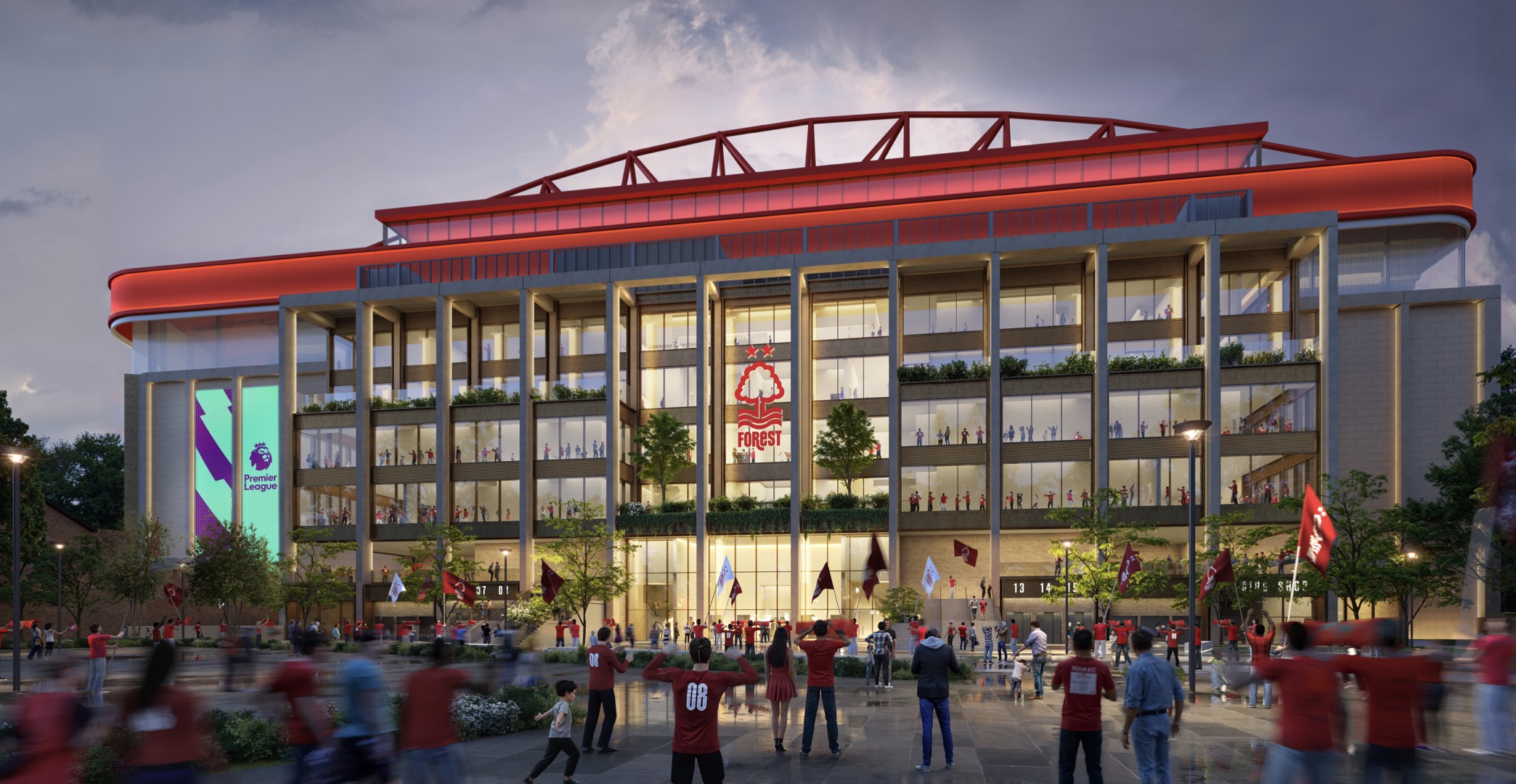
Two linked applications have been lodged with Rushcliffe Borough Council. The first is a full planning application covering the demolition and complete redevelopment of the Peter Taylor Stand, the infilling of the Trent End corners and associated public realm works. The second is an outline application establishing the principle, scale and access arrangements for a future rebuild of the Brian Clough Stand.

Together, the proposals would see the City Ground increase from its current capacity of just over 31,000 to 45,000 following completion of the first phase, and ultimately to 52,500 once the Brian Clough Stand redevelopment is delivered.

The scheme marks a significant evolution from Forest’s previous planning consent, granted in July 2025, which allowed for a 35,000-seat stadium primarily through redevelopment of the Peter Taylor Stand and was linked to an outline residential development on adjacent land. That hybrid permission, first submitted in 2019, was the product of several years of negotiation and revision, including delays caused by land acquisition issues and updated environmental assessments. The club has now moved away from that model, with the new applications focused entirely on stadium expansion and associated infrastructure rather than housing.
Forest says the updated approach reflects its return to the Premier League in 2022, qualification for European competition in 2025 and sustained demand for tickets that has left thousands of supporters unable to attend matches. The club argues that the scale of investment is necessary to secure its long-term competitiveness while keeping the City Ground as its home, rather than pursuing relocation.
Under the full application, the existing Peter Taylor Stand would be demolished and replaced with a substantially larger structure incorporating new lower, middle and upper tiers. The design allows for phased construction so the stadium can remain operational during the build, including construction over the existing Trent End roof to maintain capacity. New corner infills between the Peter Taylor Stand and Trent End, and between the Trent End and Brian Clough Stand, would create a more continuous seating bowl and improve atmosphere inside the ground.
Hospitality provision would increase significantly, with more than 5,500 hospitality seats proposed across the redeveloped stands. These spaces are designed for year-round use, allowing the City Ground to host conferences, events and community activities outside matchdays.
The plans also include the demolition of the existing club shop, Champion Centre and two boathouse buildings used by Nottingham Rowing Club, with the rowing facilities to be relocated to an alternative site under a separate planning process. Forest says the rowing club is supportive of the proposals and that the relocation will be secured before certain phases of construction can begin.
A central feature of the scheme is a major upgrade to the riverside environment. Public realm improvements would open up areas currently inaccessible to the public, enhance the Trent Valley Way footpath and cycle route, and create new plazas and gathering spaces designed to be used throughout the year, not just on matchdays.
Architecturally, the new Peter Taylor Stand would become the dominant structure on the south side of the ground, with a roofline rising to around 67 metres and a sculptural arch reaching approximately 82 metres at its highest point. The design includes a continuous red roof intended to unify the redeveloped stands and potentially extend to the rest of the stadium in future phases, alongside stone cladding referencing Nottingham’s historic sandstone.
The outline application for the Brian Clough Stand sets the maximum scale and envelope for a later rebuild that could add up to 7,500 seats. While detailed design would be brought forward through reserved matters applications, the parameters indicate a stand of comparable ambition and height to the new Peter Taylor Stand, completing a wraparound bowl and improving circulation and pedestrian routes on the northern side of the ground.
If planning permission is granted, Forest expects construction on the Peter Taylor Stand and Trent End works to begin after the end of the 2025/26 season, with the expanded 45,000-capacity stadium opening for the start of the 2030/31 season. The Brian Clough Stand redevelopment would follow later, with completion currently anticipated ahead of the 2033/34 season.
The club has held a series of pre-application workshops with Rushcliffe Borough Council and neighbouring authorities, alongside public exhibitions in December 2025 attended by more than 350 people. Forest says feedback from those sessions has informed the final scheme, particularly around transport, flood risk, noise, lighting and integration with the surrounding community.
As with previous proposals, the application site lies within a flood risk zone due to its proximity to the River Trent, but Forest argues that the stadium benefits from existing flood defences and that the redevelopment will not increase flood risk elsewhere. The council has issued a screening opinion confirming that a full environmental impact assessment is not required.
The proposals will now be considered by Rushcliffe Borough Council, with the decision expected to be one of the most significant planning determinations in the borough for many years, shaping not only the future of Nottingham Forest but also the wider Trent Bridge and riverfront area.
