Nottingham University Hospitals NHS Trust (NUH) said the prolonged heat contributed to pressures that led it to declare a critical incident in June, as staff dealt with dehydration, hyperthermia and delirium among vulnerable patients.
The Trust has also faced problems storing medicines at safe temperatures, keeping wards comfortable and managing heat generated by hospital equipment.


Duane Mclean, Deputy Chief Operating Officer at NUH, said: “This summer we have seen an increase in heat-related attendances at our emergency department and subsequent admissions to hospital, which in June contributed to us calling a critical incident.

“There can be multiple reasons contributing to pressures, but we know that the prolonged period of extreme heat experienced by our staff and patients has been part of the problem.
“We also know the symptoms being presented are commonly triggered by extreme heat, such as hyperthermia and dehydration, particularly among our older patients and those with existing health conditions.”


He said Nottingham’s hospitals were not designed for sustained high temperatures, with many older patients also cancelling outpatient appointments because they did not want to leave home during the heat.
The Trust has encountered additional challenges involving medicines that need to be stored at cooler temperatures.
Mr Mclean added: “We have also had challenges relating to the safe storage of medicines on our wards, many of which should be kept at cooler temperatures than we are seeing now, and the impact of the heat emitted by equipment in our hospitals.”
Older patients particularly vulnerable
Cheryl Broodryk, Ward Manager of the Geriatrics Admissions Unit, said dehydration can quickly lead to serious confusion and delirium among older people.
She said: “Hydration is a big factor that we have to try to teach our patients about. They are happy to have cups of tea, but the importance of water, particularly in this heat, is crucial.
“The heat and lack of hydration lead to delirium. One lady was admitted as she had become so delirious that her body was shutting down, and she was so cold that she went out in 35-degree heat wearing three coats and collapsed.”
Children with existing health problems can also face greater risks.
Thirteen-year-old April Rowen has spent much of the summer at Nottingham Children’s Hospital because of total intestinal Hirschsprung’s disease, which affects how much she can eat and drink.
Her mother, Gillian Rowen, said: “We have been in and out of the hospital for the last six years and it has always been warm, but there has been no time when it has got cooler recently.
“It’s terrible. With April’s condition, she can drink, but her body doesn’t absorb it. So, when it’s really hot, it is ten times worse.”
Hospital staff adapt to prolonged heat
NUH has responded by offering more outpatient appointments by telephone, introducing additional hydration breaks and making changes to uniforms.
Fans and portable air-conditioning units have been brought in, while patients have been offered more fluids and ice lollies.
The Trust has also increased capacity in Same Day Emergency Care, allowing some frail older patients with heat-related symptoms to receive fluids and return home without being admitted overnight.
Dr Karen Aucott, a consultant paediatrician at NUH, said working 12-hour shifts in high temperatures was exhausting for staff.
She said: “We’re sourcing fans, we have increased the number of blinds we have in our offices, are increasing and adding flexibility around breaks, and are making sure our teams are hydrated.
“We’re managing increased capacity in our hospitals and also increased care needs. We are monitoring patients very closely, thinking about those with underlying issues and additional vulnerabilities in this heat.
“Our homes and hospitals aren’t set up for this kind of heat in the UK, and we want people at home to recognise the signs before they become too unwell and need to attend A&E.”
Thermal imaging identifies hospital hotspots
NUH’s resilience team is reviewing how its buildings cope with extreme temperatures, using five years of data and thermal-imaging cameras to identify the worst-affected locations and sources of heat.
Emily Brookes, Net Zero Carbon Lead at NUH, said: “We are assessing where the complaints about heat are coming from across our sites and then using a thermal imaging camera to see those hotspots and decide what can be done.
“Some of the actions we are recommending include better insulation, better ventilation and the possibility of air-conditioning.”
The Trust has completed a programme of installing new windows at the Queen’s Medical Centre and is increasing its use of low-heat lighting.
It is also installing a renewable geothermal heating and cooling system as part of its Climate Change Adaptation Plan, which is intended to cut carbon emissions while making hospital buildings more resilient.
New rehabilitation centre designed for hotter climate
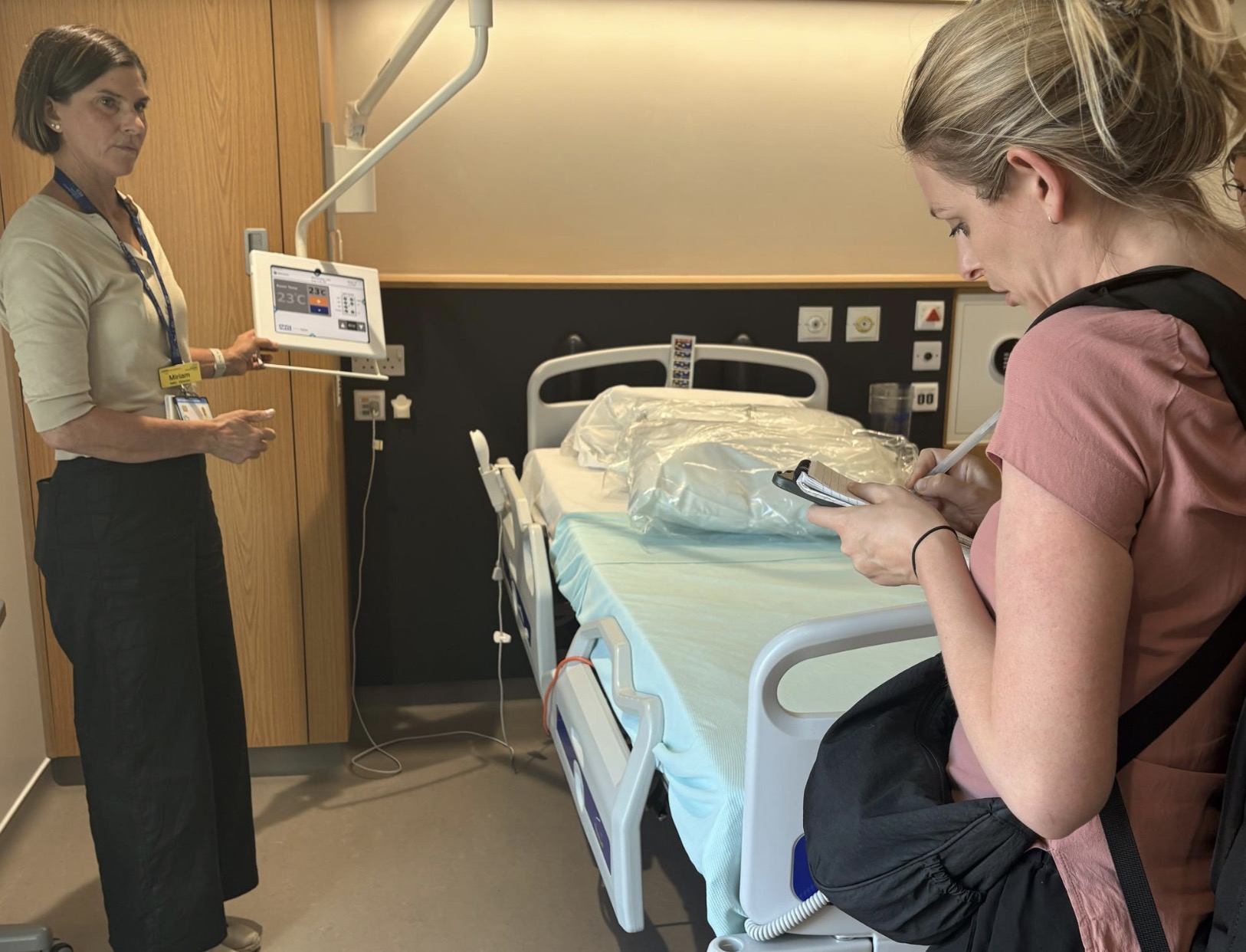
The soon-to-open National Rehabilitation Centre near Loughborough has been designed to avoid many of the problems affecting NUH’s older buildings.
The carbon-neutral hospital includes solar panels, air-source heat pumps, cooling technology and room ventilation systems that operate according to occupancy.
NRC Programme Director Miriam Duffy said: “We are very lucky to have a newly built NHS facility which is a carbon-neutral hospital fit for the future.
“It was all part of the strategic direction we needed to take in the planning, which includes solar panels, cooling systems, air-source heat pumps and even ventilation systems in each room that are activated depending on occupancy, all to limit energy usage.”
