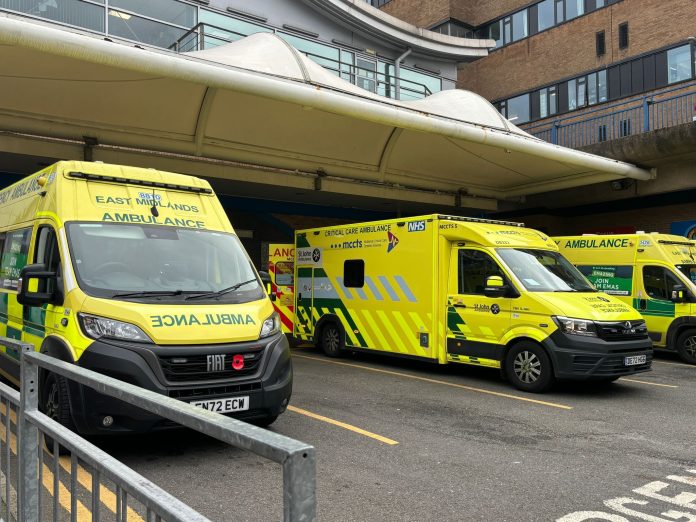
More than 9,000 people across the East Midlands waited over 45 minutes to be transferred from an ambulance to A&E during October.
The shocking figure was revealed at an East Midlands Ambulance Service (EMAS) board meeting on Tuesday (4 November) when discussing the performance of the service.
Pressure on the ambulance service has been growing in recent months, with the average handover time being 31 minutes and 37 seconds in July, rising to 35 minutes and 35 seconds in August, and 33 minutes and 39 seconds in September.
Acute hospital trusts across the region have been running a 45-minute ambulance handover scheme since late 2024 and early 2025 in a bid to free up ambulance crews to respond more effectively to emergencies.





It was introduced at Queen’s Medical Centre (QMC) in Nottingham in December 2024, at Royal Derby Hospital in January 2025, and implemented at Grimsby Hospital and Scunthorpe General Hospital in February 2025 – it began in Leicester in March.

File image
Thousands of patients across the East Midlands have been left waiting in an ambulance outside A&E for longer than 45 minutes this year – but the figure has risen by 2,500 in a month.
Speaking in the meeting, John Kelly, non-executive director, asked the board: “Do we know the number for the whole of October?”
Ben Holdaway, director of operations, told the board that around 9,000 patients were waiting longer than 45 minutes to be handed over to A&E departments in October 2025.

This is an increase from 6,500 in September, higher than 7,300 in August, and 6,100 patients both in June and July.
Dozens of EMAS vehicles were recently forced to wait outside Nottingham’s QMC on 28 October, where 26 ambulances were counted queuing outside the emergency department bringing patients in.
Mr Kelly continued: “It feels like we have this conversation nearly every month.
“Clearly, as an executive team, you’re putting as much pressure as you can on the acute trusts to try to do something about it before we get to when it’s going to be much worse – we all know it’s coming in the winter. But it’s already getting worse.
“I don’t have any sense of what could or should change so that in three months’ time it’s better.”

EMAS Chief Executive, Richard Henderson, said “elements” of the trust’s winter plan have been working, but that it would be working “very closely” to make sure extra mitigations were put in place.
In the board’s meeting documents, which provided data for September 2025 – not including October – it states that QMC had the most ambulance delays during September, with more than 2,700 hours lost and 32 per cent taking longer than 45 minutes.

Across EMAS in September, nearly 4,400 ambulance handovers took longer than an hour, with QMC accounting for nearly a quarter of this with 1,066, followed by Royal Derby Hospital with 769, and Leicester Royal Infirmary with 635.
Speaking earlier in the meeting about general ambulance delays, Jackie Jones, non-executive director, asked the Chief Executive: “Has anything occurred that has resulted in this sudden problem, or is this now how we expect it to be over the winter period?”
Mr Henderson responded: “I don’t accept or expect it to be like this, and there are different reasons at different hospitals.
“I have spoken personally with a number of senior colleagues and chief executives to better understand the position and what actions are being taken to address this, and I don’t believe it is the same issues at the different hospitals.
“But the net impact of that is there are many instances where our vehicles are queuing and we’re unable to respond to the patients – the longer that takes, the longer it takes for us to be able to respond in the community.”
Oliver Newbould, associate non-executive director, asked what impact the delays had on patients waiting in their homes for an ambulance.
Keeley Sheldon, director of quality, said: “We’re monitoring those elements, monitoring professional minimum care standards and the impact of that on patient safety, deteriorations during delay, or clinical intervention… there are minimum care standards that are reported on a daily basis.”
Mr Henderson told the board that the Midlands is “more problematic” for ambulance handover delays and that focus must be given to improving timings in the larger acute hospital trusts so that other hospitals do not end up with large amounts of deflected, unplanned demand.