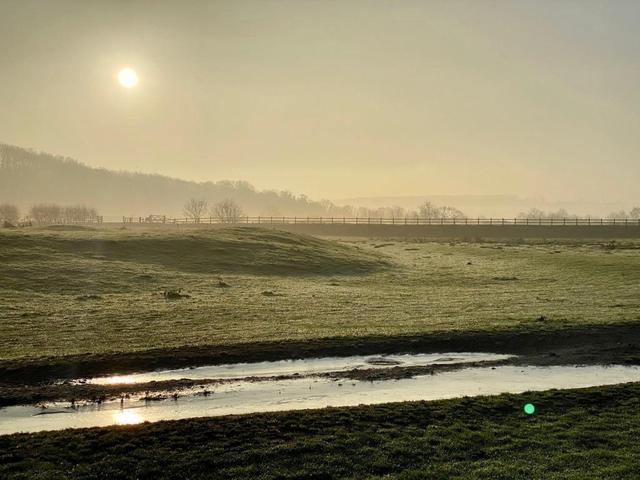
Rushcliffe Borough Council has reaffirmed its objection to plans for a new sand and gravel quarry near Barton in Fabis, saying the revised proposal from Land Logical Limited remains “inappropriate development” within the Green Belt and continues to pose unacceptable environmental, amenity and landscape impacts.
This report ahead of a Rushcliffe Borough Council planning meeting next week, is expected to recommend that this latest response is approved by Rushcliffe’s planning committee, and sent to Nottinghamshire County Council, which will determine the application.
Note: It isn’t a decision, as that will be made by Nottinghamshire County Council – it is a response by the borough as requested by the county.
It follows additional information submitted by the applicant under Regulation 25 of the Environmental Impact Assessment Regulations, after the County Council requested further detail on several aspects of the scheme.
The development, covering land off Green Street and Mill Hill to the north of Barton in Fabis, would involve the extraction, processing, sale and distribution of sand and gravel, along with restoration works and associated highway and access improvements. A 12-metre-high processing plant, conveyor, wheelwash, weighbridge, car park and office buildings would form part of the operation.




Rushcliffe Borough Council first considered the quarry application in May 2025 and objected at that time on multiple grounds. The authority cited harm to the openness of the Green Belt, contamination risk, impacts on residential amenity, landscape character, noise, dust, air quality and ecology, as well as the cumulative effect of the quarry alongside existing and future housing developments in the area.
While the developer has since submitted new reports and minor amendments, including adjustments to the proposed permissive path around the site, small boundary changes for ecological reasons, and an updated restoration plan incorporating additional biodiversity features, Rushcliffe’s planning officers concluded that these did not address the fundamental concerns previously raised.
Environmental Health officers reviewed the updated noise and air quality assessments but maintained concerns about potential disturbance from tonal noise generated by diesel generators and quarry machinery. The revised dust management plan now proposes continuous dust monitoring with trigger levels for remedial action, but the council’s experts said these updates do not alter the overall conclusions about the likely effects on residents’ amenity.
The council’s response also highlights the UK Health Security Agency’s advice that quarry operations must comply with the Health and Safety Executive’s exposure limits for respirable crystalline silica dust, a potential risk to human health from fine particles. Rushcliffe’s officers said it remains unclear whether adequate safeguards are in place to prevent public exposure.
Ecologically, the updated submission includes minor modifications to protect Brandshill Grassland and new calculations of Biodiversity Net Gain (BNG). The revised plan predicts a 23.98% net gain in habitat units, 31.97% in hedgerows, and 8.85% in watercourses. However, these gains are slightly lower than before due to reclassification of some grassland areas. The council said that despite the changes, its original ecological concerns remain, particularly regarding the protection of the endangered Necklace Ground Beetle, whose habitat lies within the affected area.
In reaffirming its objection, Rushcliffe Borough Council stated that the quarry proposal remains “inappropriate development in the Green Belt by virtue of its size, scale and location,” arguing that no “very special circumstances” have been demonstrated to justify approval. The council also rejected the notion that the site qualifies as “grey belt” land, a term occasionally used to describe previously disturbed areas within the Green Belt.
The Borough Council also reiterated that the County Council has not been fully satisfied that the proposed development would avoid significant adverse effects in relation to contamination, landscape, rights of way, noise, dust, air quality and ecology.
If the County Council ultimately decides to approve the quarry, Rushcliffe has recommended a comprehensive list of planning conditions covering noise limits, dust management, lighting controls, ecological protection and restoration requirements. These include strict limits on daytime and night-time noise, mandatory use of white-noise reversing alarms on vehicles, annual noise monitoring plans, restrictions on operating hours to between 7am and 6pm on weekdays and half-days on Saturdays, and no working on Sundays or public holidays.
Further conditions proposed by the Borough Council include ongoing biodiversity monitoring, measures to protect badgers and the Necklace Ground Beetle, detailed restoration and landscaping plans, and the replacement of any trees lost during the operation.
Rushcliffe’s latest report concludes that, despite the additional technical material provided by the applicant, “the scale of development proposed remains as previously reported,” and therefore the borough’s position “should remain unchanged.”
The long-running Barton in Fabis quarry proposal has drawn widespread local opposition since it was first put forward. Residents and campaign groups, including Barton in Fabis Parish Council, have voiced concerns about the impact on local roads, air quality, wildlife and the rural setting of the Trent Valley. The land lies within a sensitive landscape close to the River Trent and adjacent to existing conservation and recreational areas used by walkers and birdwatchers.
The County Council, as the minerals planning authority, will now consider Rushcliffe’s response alongside those of statutory consultees, residents and environmental bodies before deciding whether to grant permission. No date has yet been confirmed for when the application will return to the County Council’s planning committee for determination.