
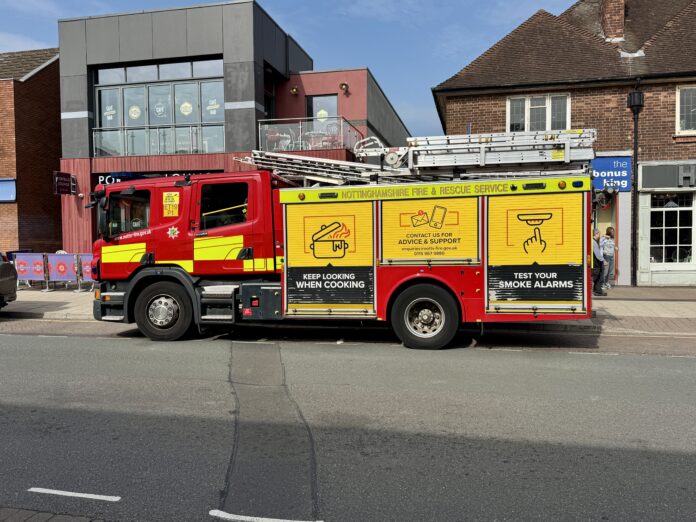
Firefighters across Nottinghamshire are set to adopt a new model for responding to complex rescue incidents, with specialist capabilities redistributed to several stations across the county over the coming years.
A report by Nottinghamshire Fire and Rescue Service outlines plans to change how technical rescue skills and equipment are organised, with the new approach expected to be introduced during 2026/27 and fully implemented by April 2028. The proposals will be considered by the Nottinghamshire and City of Nottingham Fire and Rescue Authority’s Community Safety Committee on 20 March.
Technical rescue incidents include situations that require specialist capabilities beyond traditional firefighting, such as rescues from water, at height or in confined spaces, as well as incidents involving large animals or bariatric patients. These types of incidents occur on road, rail and tram networks, as well as in buildings or natural environments.
• Fire crews rescue person from flood water in Nottinghamshire
Since 2016 these specialist capabilities have largely been delivered by crews based at Highfields and Newark fire stations. Over the last five years those crews have attended an average of 318 technical rescue incidents each year.


The review of the current system began towards the end of 2024 as the service examined whether the existing model remained suitable for future risks. The review also coincides with the planned replacement of the service’s two Specialist Rescue Units, which have been in operation since 2012 and are due to reach the end of their operational life in January 2027.

As part of the review, the service analysed operational data, examined how other fire and rescue services deliver technical rescue capabilities and considered the findings of the 2024 Fire Cover Review, which assessed the best locations for specialist resources across the county. Engagement sessions were also held with firefighters, station watches and representatives of the Fire Brigades Union.
• Fire service review shows four fatal fires across Nottinghamshire in 2025
The discussions identified several challenges with the current system. These included the difficulty for crews at two stations to maintain a wide range of specialist skills, the limited availability of suitable training facilities in the county, and the fact that when the specialist vehicles are deployed to an incident, other technical capabilities can temporarily become unavailable.

Under the proposed new model, different technical capabilities will be distributed across several stations to allow firefighters to specialise in specific skills while improving overall resilience. Bariatric rescue and rope rescue capabilities are planned to move to Carlton and Arnold fire stations, while heavy rescue and shoring operations will be based at Edwinstowe.
Large animal rescue will remain at Newark, while swift water and flood rescue capabilities will continue to operate from both Highfields and Newark. Structural access capabilities are planned to move to West Bridgford fire station, and object removal equipment will be available from all wholetime stations across the service.

The transfer of structural access capabilities to West Bridgford will
necessitate adaptions to its fire appliance to stow additional equipment. A
structural access training rig is to be built, and various items of equipment
and PPE considered to enhance this capability.
The changes will involve new equipment, modifications to vehicles and the development of specialist training facilities. For example, a rope rescue training rig is proposed at Carlton, while a shoring training rig is planned for Edwinstowe. Additional vehicles and equipment will also be required at several stations to support the new capabilities.
The report states the changes will allow the service to improve specialist training, increase the number of firefighters qualified in particular skills and ensure that technical rescue capabilities remain available even when other specialist teams are responding to incidents.

The project will be funded through an existing £1.68 million budget within the service’s approved capital programme. A transfer window has already opened to allow firefighters to volunteer for moves to stations that will host new specialist roles, with further workforce engagement planned as the implementation progresses.
Fire authority members are being asked to note the progress of the review and support the approach to implementing the new technical rescue delivery model across the service.
