
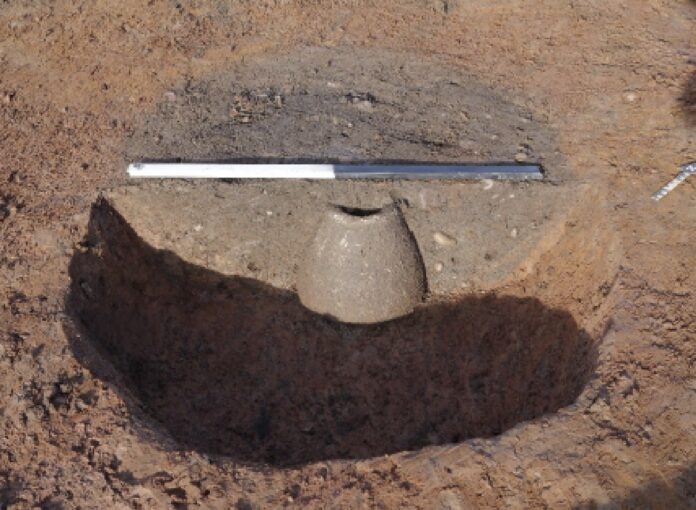
An archaeological discovery has been made during ongoing investigations at Fairham in Nottinghamshire, revealing further evidence of the area’s rich prehistoric past.
Archaeological mitigation works carried out within Phase 11 of the development, in Rushcliffe, uncovered what experts believe could be one of the finest examples of an Iron Age “beehive” quern ever discovered in the UK.
The investigations formed part of a wider programme of archaeological work across the site. On this occasion, two excavation areas were explored, focusing on a large enclosure ditch and a prehistoric pit alignment linked to features identified during previous phases of investigation.
The standout discovery was a complete upper stone from a rare beehive quern, a type of circular grinding stone used during the Iron Age for milling grain into flour. Archaeologists believe the object had been carefully and deliberately placed within a pit as part of a ceremonial or ritual act thousands of years ago.
One specialist involved in the excavation from PCAS Archaeology Ltd described the find as:


“The beehive quern, which was clearly a very special deposit, is quite spectacular and possibly the best example in the country.”
Alongside the quern, archaeologists also uncovered part of a potentially extensive enclosure system and seven pits associated with a prehistoric pit alignment, helping to build a greater understanding of the ancient landscape that once occupied the area.
The discoveries represent the latest chapter in an extensive archaeological programme undertaken at Fairham, where significant investment has been made to ensure the preservation and recording of the site’s heritage as development progresses.
The findings will contribute to the ongoing archaeological record for the region and provide valuable new evidence about Iron Age activity in Nottinghamshire.
Once the final report has been approved, all archaeological records and finds from the project will be carefully organised and archived in line with national standards. This includes written records, drawings, photographs, GIS data, artefacts, and environmental samples.
The archive will be securely stored by PCAS until a suitable museum is appointed to receive it. A digital copy of the final report will also be uploaded to the national archaeological database through the OASIS scheme.
