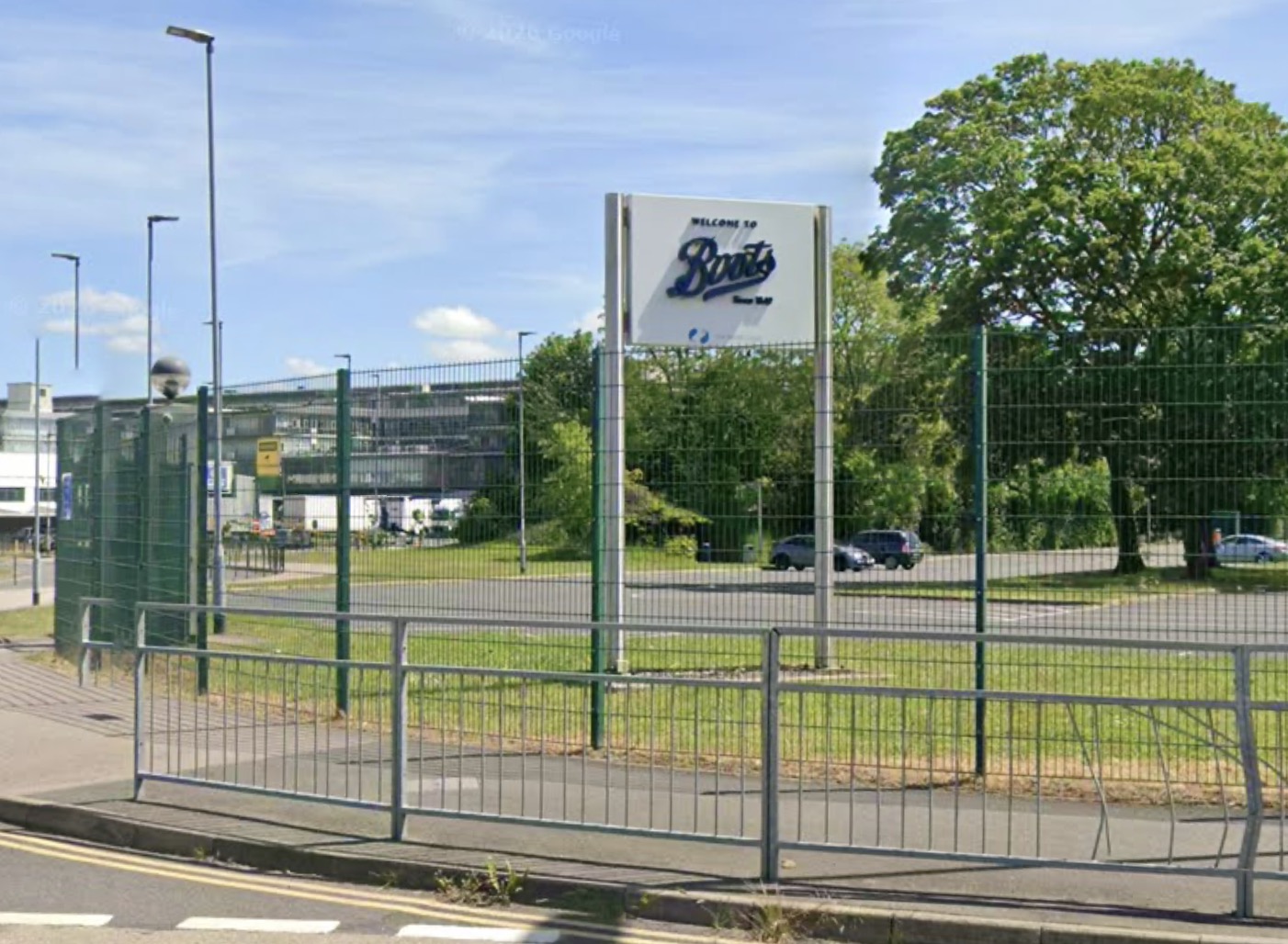
Boots has been granted planning permission to extend a warehouse at its Nottingham campus, supporting a wider multimillion-pound investment in automated handling equipment.
Nottingham City Council approved the extension to the D105 building at the Boots campus, Thane Road, on 30 September.


The development will provide additional space for the secure storage of medicines, including a partly temperature-controlled storage area.
A planning statement submitted on behalf of Boots says the extension will enable a wider investment in automated mechanical handling within the existing warehouse, helping the company maintain its medicines supply chain and meet regulatory requirements.
The extension will project from the south-western side of the building and measure approximately 62 metres long by 37 metres wide. It will match the height and roof profile of the existing warehouse, with light grey cladding.
The planning statement describes the project as supporting continued investment and safeguarding jobs at the Nottingham campus. However, staffing levels are expected to remain unchanged, while the overall volume of HGV traffic entering and leaving the site will remain broadly the same.
The development will remove 31 car parking spaces and three HGV spaces. The council’s highways assessment noted that no cars were parked in the affected area during a visit in December 2025.

Highways officers raised no objection, concluding that the extension would have little direct impact on the public road network.
An existing fire access track will be diverted around the new building, while pedestrian access will be provided along its outside edge. The footbridges linking D105 with the neighbouring D82 building will be retained.
Council officers considered the design appropriate for the industrial campus and found that it would not cause significant problems for nearby residential properties.
They also concluded that the impact on listed buildings elsewhere within the Boots campus would be negligible, given their distance from the extension and the buildings between them.
Flood risk was among the issues examined during the application. The Environment Agency and the council’s flood risk team initially objected because of insufficient site-specific information.
Further submissions included a revised flood risk assessment and an attenuation pond, which must be completed before the extension comes into use. Detailed drainage arrangements also require council approval.
The development will involve the loss of grassland, trees and other vegetation. Boots must provide evidence that it has secured off-site biodiversity units to compensate for habitat losses and meet the scheme’s biodiversity net gain requirement.
Other conditions include measures to protect wildlife during construction, the provision of two bat boxes and two bird boxes, and controls on external lighting.
Work must begin within three years of the permission being granted.
