
Labour-led cities across the East Midlands are set to expand their boundaries under local government reorganisation plans approved by the Government, prompting sharply divided reactions from council leaders, MPs and residents.
Ministers announced on Thursday 16 July that proposals centred on larger Nottingham, Derby, Leicester and Lincoln authorities had been selected as part of a wider replacement of the current two-tier council system.


The four cities are all governed by Labour administrations ( Derby is a minority controlled authority ). Supporters say the new boundaries better reflect modern travel, employment and economic patterns and will allow councils to provide services more efficiently. Opponents have accused ministers of ignoring local consultation results, weakening county areas and favouring proposals supported by Labour-run city councils.
Communities Secretary Steve Reed has rejected accusations that the decisions amount to political “gerrymandering”, saying most of the proposals selected by the Government had attracted cross-party support.
Mr Reed said local government reorganisation offered a “once-in-a-generation opportunity” to create councils that were financially sustainable, capable of delivering public services and more closely aligned with the communities and economies they served.

In Nottinghamshire, all nine existing councils will be abolished and replaced by two unitary authorities. One will combine Nottingham with parts of Broxtowe, Gedling and Rushcliffe, including West Bridgford, Beeston and Arnold. The second will cover Ashfield, Bassetlaw, Mansfield, Newark and Sherwood and the remaining parts of the three boroughs adjoining the city.

Nottingham City Council leader Cllr Neghat Khan said the selected proposal recognised that Greater Nottingham operated as a single economic area, with large numbers of people travelling across existing council boundaries for employment, education, healthcare, shopping and leisure.
She said two unitary councils based around the area’s urban and rural communities would be more responsive, accountable and sustainable.
However, the decision has been strongly opposed by Conservative and Reform UK councillors in the county.
Nottinghamshire County Council’s Reform UK leader, Cllr Mick Barton, said his group did not support local government reorganisation but had been required to work within the framework established by the Government.
He accused ministers of selecting options associated with Labour-run cities and said the county council would consider whether a judicial review represented the most appropriate response.
Rushcliffe Borough Council leader Cllr Neil Clarke has also called for a judicial review over the division of the borough and the inclusion of West Bridgford and surrounding communities in the expanded Nottingham authority.
Conservative councillors at County Hall have claimed that assets valued at around £250 million could be transferred to the expanded city authority. Opposition leader Cllr Sam Smith said the division of Rushcliffe, Broxtowe and Gedling risked weakening the remaining county area and affecting its financial base.
Cllr Barton dismissed the Conservatives’ intervention as a publicity stunt and said the previous Conservative administration had failed to resolve the question of local government reform during its time in control.
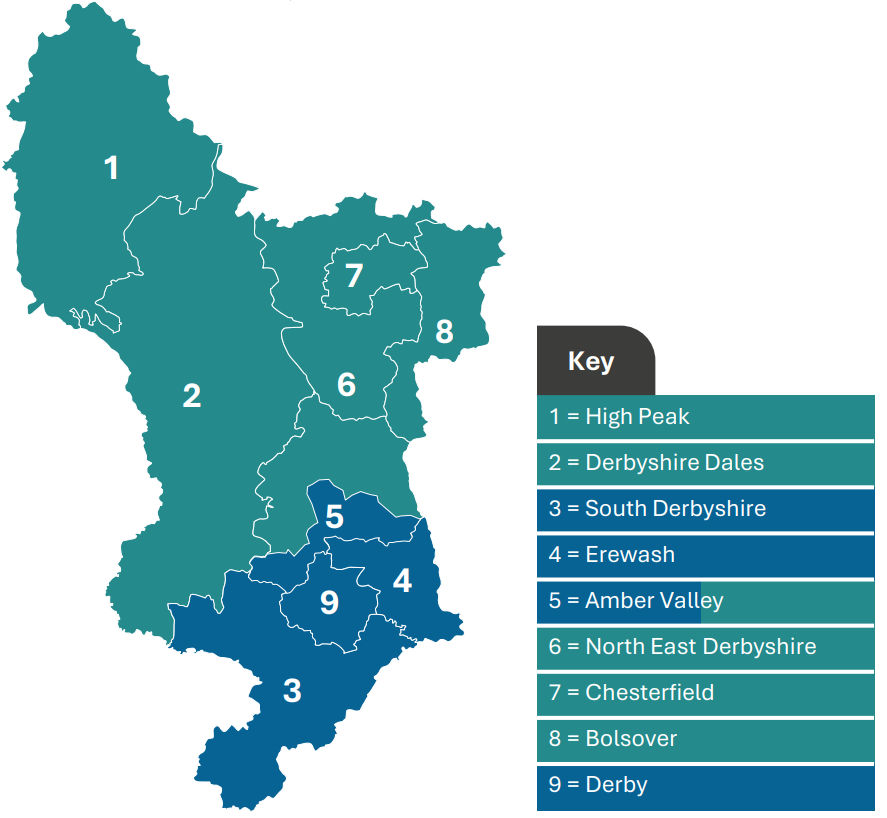
In Derbyshire, the Government has approved a north-south division under which all ten existing councils, including Derby City Council, will be replaced by two authorities.
The northern authority will include Bolsover, Chesterfield, Derbyshire Dales, High Peak, North East Derbyshire and 21 parishes from Amber Valley. The southern authority will comprise Derby, Erewash, South Derbyshire and 14 Amber Valley parishes.
The plans could reduce the number of councillors across the area from 447 to around 162, although the final number has not been confirmed.
Derbyshire County Council’s Reform UK leader, Cllr Alan Graves, accused the Government of favouring options backed by Labour-run city councils. He said ministers should have selected the county council’s proposal for a single Derbyshire authority serving more than one million residents.
Cllr Graves claimed the two-authority model would produce fewer savings and leave the northern authority with a weaker financial and economic base. He nevertheless said the county council would now work to ensure the new arrangements were introduced on time.
Mr Reed rejected the allegation of gerrymandering and said the priority was to proceed with reforms intended to secure savings and support economic growth.
The decision has also caused disappointment in Amber Valley, which will be divided between the two authorities despite the borough council favouring an option that kept the area intact.
Amber Valley Borough Council leader Cllr Chris Emmas-Williams said proposals to divide the borough had received the lowest support in its public consultation. He said the council would examine the implications while continuing to provide existing services.
Conservative opposition leader at Derbyshire County Council Cllr Alex Dale said residents in communities surrounding Derby had made clear that they did not want to be absorbed into a larger Derby-based authority.
He also questioned whether the northern authority would receive sufficient funding to address rurality, deprivation, health inequalities and an ageing population.
Chesterfield Borough Council leader Cllr Tricia Gilby welcomed the announcement, describing it as an opportunity to modernise services and give the new councils the capacity and resilience needed to support their communities.
South Derbyshire District Council leader Cllr Robert Pearson said the announcement brought clarity after 18 months of uncertainty and that the authority would continue concentrating on existing services during the transition.
The chief executives of Derbyshire’s ten councils warned shortly before the decision that much of the initially forecast financial saving from reorganisation had disappeared as the likely transition costs became clearer.
In Leicestershire, Leicester’s boundary will be extended to include Oadby, Wigston and areas around Syston, Enderby, Great Glen, Braunstone Town, Blaby, Anstey and Glenfield. The remaining county area and Rutland will be served by a second unitary authority.
Leicester mayor Sir Peter Soulsby said the city’s existing boundary had been tightly constrained for decades and no longer reflected the continuous urban area surrounding it.
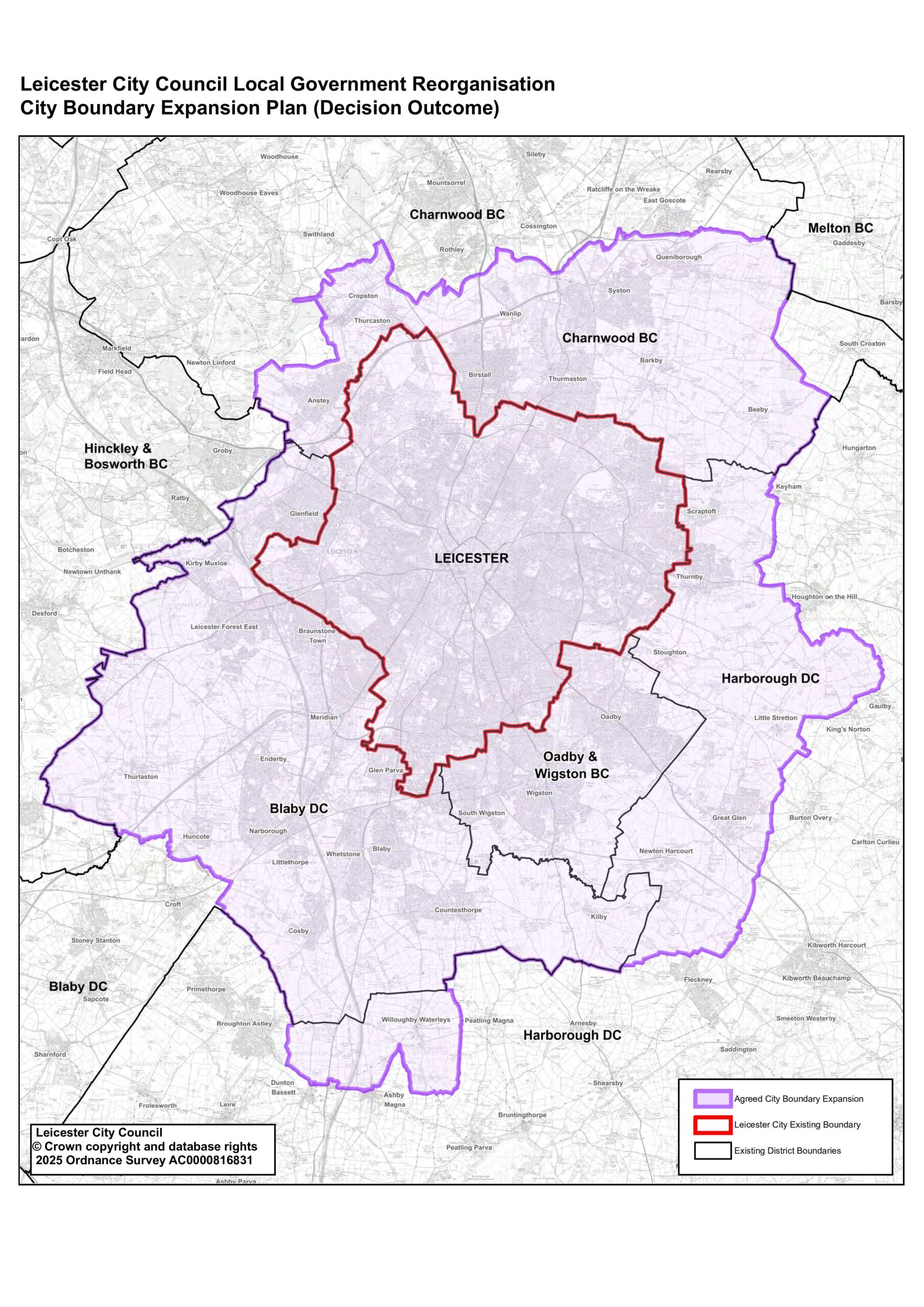
He said many residents immediately outside the boundary depended on employment and services within Leicester but had no vote in how the city was governed. Extending the boundary, he argued, would give those communities a greater say and provide space for future housing and employment.
The Government said Leicester’s restricted boundary had limited its ability to meet housing and employment land requirements. Ministers believe the expansion could release land for thousands of homes and substantial employment development over the next 20 years.
Sir Peter said the change was overdue because Leicester had not benefited from the boundary expansions granted to several other English cities during the 1970s. He also said he was confident that savings from the new structure would repay the cost of the transition.
Labour MP Amanda Hack said the simplified system would make it easier for residents to identify and hold decision-makers to account while delivering better value for taxpayers.
Leicestershire County Council leader Dan Harrison, of Reform UK, said he was “furious, shocked and bitterly disappointed”. He described the expansion as costly and disruptive and said the authority was taking legal advice about a possible challenge.
Mr Harrison said no final decision had been made on legal action but maintained that communities had not been listened to. He said council officers would nevertheless work with authorities across Leicester, Leicestershire and Rutland to protect services during the transition.
Conservative MP Neil O’Brien said residents opposed higher council tax and feared losing their local identities. Liberal Democrat county group leader Michael Mullaney described the expanded city and single county authority as the “worst of all worlds”, arguing that decisions would be taken further away from local communities.
North Leicestershire Green Party representatives also criticised the decision, saying repeated consultations had demonstrated opposition to extending Leicester’s boundary.
In Lincolnshire, the Government selected a proposal submitted by the Labour-run City of Lincoln Council. It will place Lincoln and neighbouring communities in parts of North Kesteven and West Lindsey within one new authority, while a second will serve the rest of the current Lincolnshire County Council area.
Lincoln city leader Cllr Naomi Tweddle said different areas required different solutions and that the new authority would allow Lincoln and communities connected to it through transport, employment and economic links to shape their future together.

She said it would have sufficient scale to provide high-quality services while ensuring decisions affecting Lincoln were made by representatives who understood the city.
Some residents in villages that will join the Lincoln-based authority have raised concerns that rural communities could be overlooked.
Residents in Nettleham said they valued their existing relationship with local councillors and feared villages could become secondary to the city’s priorities. Others questioned how savings would be achieved once redundancy, restructuring and transition costs were taken into account.
Lincolnshire County Council leader Cllr Sean Matthews said the selected proposal had been his second choice. He raised concerns about the financial sustainability of an authority combining Lincoln with extensive suburban and rural areas.
He said dividing countywide services, particularly those supporting children and vulnerable adults, would be complicated, but councils now had to make the chosen arrangements work.
West Lindsey District Council leader Cllr Jackie Brockway said she was disappointed that the Government had divided the district despite previously indicating that established council boundaries would be split only in exceptional circumstances.
North Kesteven District Council leader Cllr Richard Wright said politicians must now ensure that services were distributed fairly across the new authorities. He stressed that there would be no immediate changes for residents.
Across all four areas, existing councils will continue operating during the transition. Elections to the shadow authorities are expected in May 2027, with the new councils due to assume responsibility for services in April 2028.
The detailed division of property, debts, staff, contracts and services has not yet been completed. Those arrangements will be negotiated during the transition, meaning claims about the eventual distribution of assets or the precise level of savings remain contested.
By Eddie Bisknell, Local Democracy Reporter, Chris Harper, Local Democracy Reporter, Joe Locker, Local Democracy Reporter, Jamie Waller, Local Democracy Reporter and Nigel Slater, Local Democracy Reporter.