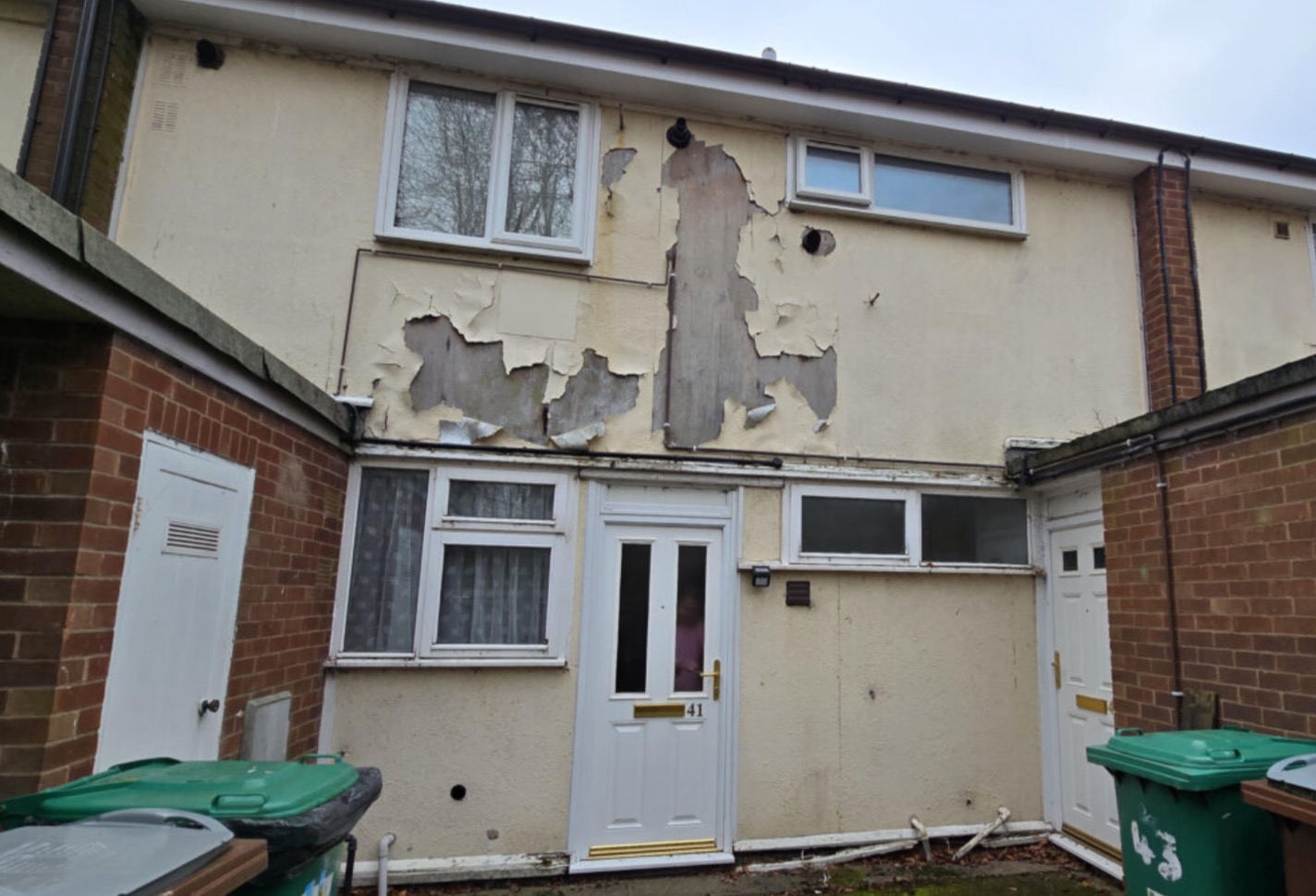
Nottingham City Council has spent around £1.3 million responding to significant damp and mould cases so far in 2026/27, as it prepares for wider housing safety duties under Awaab’s Law.
A report to councillors says Housing Services received 1,461 requests for significant damp and mould inspections and 88 emergency hazard reports between April and September 2026.



The council reported meeting all four of its published Awaab’s Law performance measures in September, following earlier difficulties with implementation, IT systems and high referral volumes.
Councillors will examine the findings at a scrutiny meeting on 16 November. They are being asked to make comments or recommendations and decide whether further scrutiny is needed. The report does not seek approval for a new spending allocation.
The council manages approximately 24,000 homes. Almost 30 per cent were built before 1940 and around 4,500 have non-cavity walls, which the report says can make properties more susceptible to low internal temperatures and condensation where heating, insulation or ventilation are insufficient or under-used.
The first phase of Awaab’s Law came into force on 27 October 2025, introducing statutory duties relating to significant damp and mould and emergency hazards. Councillors previously examined the council’s work on damp and mould in June 2025, before those requirements took effect.
In September, all 237 significant damp and mould inspections were completed within the required 10 working days. The proportion completed on time had risen from 89 per cent at the start of implementation to 97 per cent in August and 100 per cent in September.
Investigations now take an average of 6.2 days, according to the report.
The council also recorded full compliance in September for responding to emergency hazards within 24 hours, issuing written findings within three working days and physically starting remedial works within 12 weeks. The measure for starting works had stood at 93 per cent in August.
These figures measure responses, investigations, written findings and the start of remedial work, rather than confirming that every repair had been completed.
The report identifies condensation as the main cause in 55.8 per cent of damp and mould cases, followed by penetrating damp at 38.3 per cent, rising damp at five per cent and other causes at 0.9 per cent.
Officers say cases often involve interconnected problems and inspections must identify the underlying cause rather than treat visible symptoms alone. Investigations consider structural defects, heating, ventilation, environmental conditions and household circumstances.
Reports are assessed when received, with residents’ vulnerability and potential health impacts used to determine priorities. The council says temporary accommodation will be offered where a home cannot be made safe within the required timescale and residents may be at risk.
Support is also available where financial hardship or fuel poverty affects a tenant’s ability to heat their home. This includes benefits and energy advice, hardship assistance and access to the Crisis and Resilience Fund for essential utility costs or meter top-ups.
The report says advice on heating, ventilation and condensation should be given without attributing blame to residents.
Alongside responding to reported problems, the council is using property surveys, repairs records, housing visits and safeguarding referrals to identify homes at greater risk. By the end of September, access had been gained to 19,851 homes, equivalent to 82.9 per cent of the stock, to complete condition and housing health and safety surveys.
Around 70 per cent of council homes currently have an Energy Performance Certificate rating of C or above. Investment is being directed towards lower-rated properties, with an objective of bringing all council homes to at least EPC C by 2030.
A £40.5 million, four-year Warm Homes Programme is targeting 2,427 EPC D properties and areas with higher levels of fuel poverty. A separate social housing decarbonisation programme has delivered improvements to 329 properties.
The council is also considering environmental monitoring in a sample of 100 homes, selected using damp and mould cases, property condition information and retrofit programmes. This remains an option under consideration.
According to the report, the second phase of Awaab’s Law takes effect on 30 November 2026, extending duties to a broader range of hazards presenting a significant risk of harm.
These include excess cold and heat, fire and explosion, electrical hazards, structural collapse and falling elements, falls, and domestic hygiene hazards.
Preparations include changes to procedures and reporting systems, staff training, checks on workforce and contractor capacity, and arrangements for communicating with residents.
Officers warn that the wider duties may increase the number of cases, inspections, monitoring requirements and remedial works. Current budgets reflect the demands of the first phase, with future funding needs to be monitored through the council’s medium-term financial planning and Housing Revenue Account business plan.
The report also identifies recruitment and retention pressures, contractor capacity, access to properties and additional financial demands as risks.
The council’s immediate priority is to complete preparations for the second phase while maintaining its existing performance and addressing the underlying causes of unsafe housing conditions.
