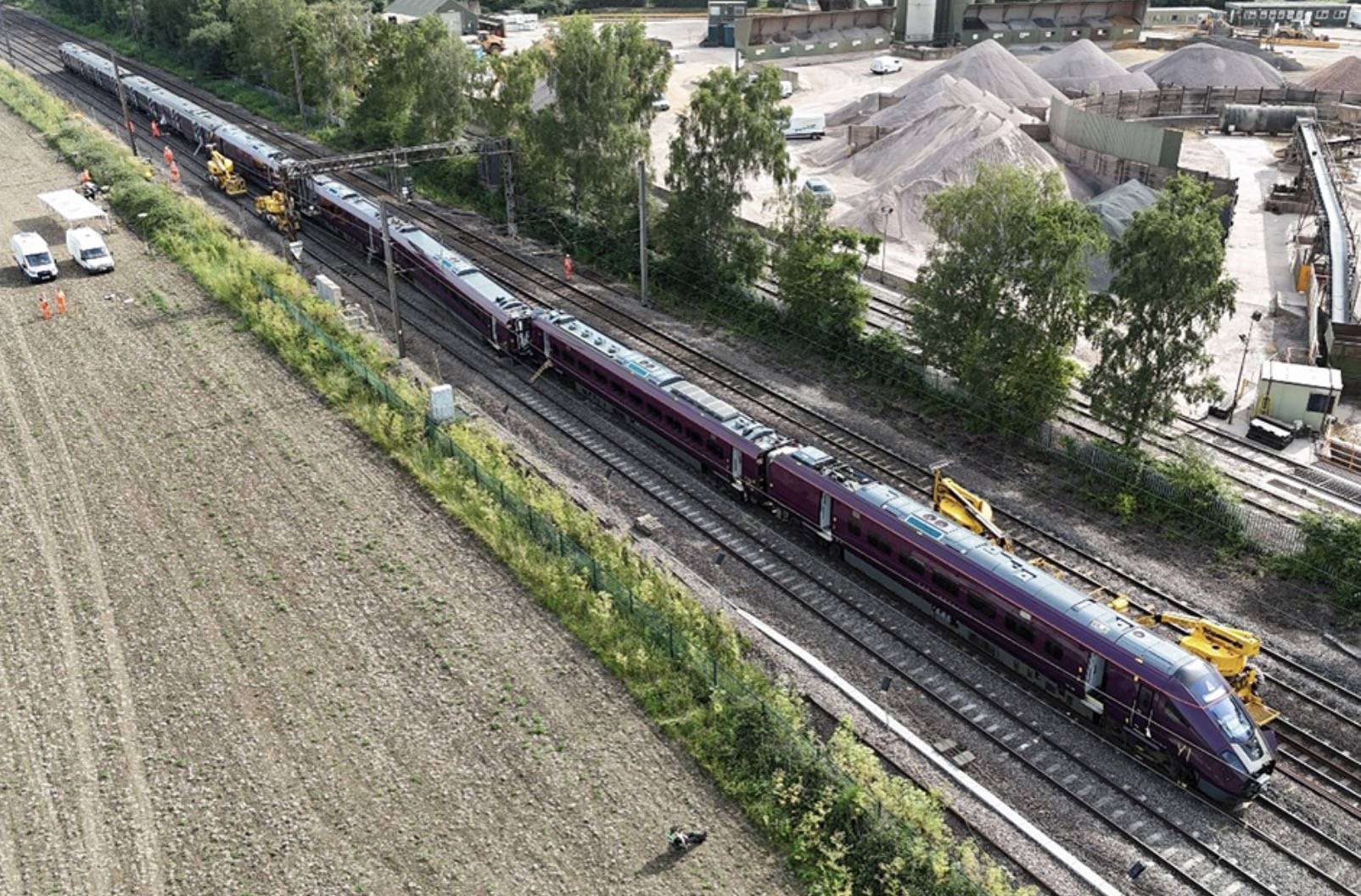
Investigation into a collision between two passenger trains near Elstow, Bedfordshire, 19 June 2026.
The Rail Accident Investigations Branch ( RAIB ) said today:


At around 17:15 on Friday 19 June 2026, train 1H46, the 16:40 East Midlands Railway service from Corby to London St Pancras, collided with train 1B67, the 15:50 service from Nottingham to London St Pancras, also operated by East Midlands Railway. The collision took place on Network Rail’s Midland Main Line approximately 2.5 miles (4 km) south of Bedford station.
The driver of train 1H46 died as a result of the accident. One hundred and sixty-two people were injured, 102 of whom required hospital treatment. At the time of writing, 53 people remain in hospital, 8 in a critical condition. Significant damage was caused to both trains, which also partially derailed.
RAIB was notified of the accident at 17:27 and immediately deployed a team to the site, with the first inspector arriving at 18:26. RAIB continues to work alongside the British Transport Police, the Office of Rail and Road, and the railway companies involved to secure the necessary evidence to support its independent safety investigation.
The on-train data recorders (OTDRs, sometimes called ‘black boxes’) from the trains have been recovered. Some of these recorders were located within damaged parts of the trains and could only be extracted during recovery operations. CCTV recordings, signalling data, and recordings of radio communications have also been obtained.
The vehicles involved have been surveyed for internal and external damage, including using laser scanning and an aerial survey. RAIB inspectors are also overseeing the testing of signalling equipment in the area.
The recovery of the trains involves vehicles being lifted by crane and moved by road to secure storage. RAIB inspectors are liaising with rail industry recovery teams to ensure access is available to them to undertake this work, which is expected to take several days. RAIB is also liaising with Network Rail to facilitate the repair work needed to restore railway operations.
The accident took place on the Midland Main Line between Bedford and Flitwick stations. The railway here has four tracks consisting of the Up and Down Fast lines (which direct trains towards London and away from London, respectively) and the Up and Down Slow lines. The collision took place on the Up Fast line on approach to WH152 signal, which is located at 47 miles and 29 chains. The maximum permissible speed for trains at this location is between 125 mph (201 km/h) and 100 mph (161 km/h), depending on the type of train.

Train 1H46 was a four-car Class 360 electric multiple unit. Train 1B67 was a five-car Class 810 bi-mode multiple unit.
RAIB’s preliminary examination has found that train 1B67 was standing next to WH152 signal when the accident occurred. The train had come to a stop unexpectedly because a fault had developed with the Automatic Warning System (AWS) equipment fitted to it, which caused the brakes to apply.
Data from railway systems recorded that the track circuit for the section of track on which train 1B67 was standing was shown as occupied. The signal interlocking would have therefore changed the signal behind the train, WH154, to display a red (danger) aspect, with the intention of protecting train 1B67 from other train movements.
WH154 is a four-aspect automatic signal. This means that the aspect it displays changes automatically depending on the occupation of track circuits by trains, without the intervention of the signaller. WH154 signal is fitted with AWS track equipment, which provides an audible and visual warning to train drivers on the approach to infrastructure features, including signals. AWS uses track-mounted magnets which trigger receivers fitted on trains. The system on board the train sounds a bell or chime when approaching a signal displaying a green aspect, and a horn when approaching a signal displaying any other aspect. This warning is intended to alert the driver to the upcoming signal or speed change. When receiving a horn warning, a driver must acknowledge this by pressing a button in the cab. After an AWS warning is acknowledged, a visual indicator will appear in the cab as a reminder of the warning. If the warning is not responded to within a short timeframe, the train’s emergency brake is applied.

Data from railway systems records train 1H46 leaving platform 1 at Bedford station at 17:10 on the Up Slow line. As it left the platform, forward-facing CCTV (FFCCTV) images show that the train passed a yellow (caution) signal, which signifies that the driver can pass the signal but should be prepared to stop at a red signal ahead.
Train 1H46 continued on the Up Slow line until it reached Bedford South Junction, where it crossed onto the Up Fast line. The signal protecting the junction was also displaying a yellow aspect as the train passed it.
Having entered the Up Fast line, train 1H46 then approached signal WH154. FFCCTV shows that this signal was displaying a red aspect as the train approached and then passed it. The data downloaded from the OTDR on the front vehicle of this train is still being analysed, as the recorder could not be accessed until the vehicle was recovered. This means that it is not yet possible to say what indication the driver received from the AWS equipment on the train or how they responded to this.
The OTDR from the rear vehicle of train 1H46 has been recovered and downloaded. While this OTDR does not record AWS activity, it does record the train’s speed and braking commands. Preliminary analysis of data from this OTDR shows that there was a brake activation around 9 seconds before the collision, while the train was travelling at approximately 76 mph (122 km/h). Preliminary analysis of OTDR data also indicates that the train was travelling at around 49 mph (79 km/h) at the point of collision.
Some of this information may be refined as RAIB’s investigation progresses. RAIB continues to analyse evidence relating to the sequence of events, the performance of the signalling system, and the speed at which the collision occurred, all of which remain under investigation.
Our investigation will seek to identify the sequence of events which led to the accident. It will include consideration of:
the actions of those involved and any factors that may have influenced them
the status and performance of the braking, AWS, and other safety systems on train 1H46
the reason train 1B67 stopped
the status of signal WH154 and its AWS equipment, as well as its positioning, visibility, and conspicuity
the crashworthiness performance of both trains during the collision
the emergency response to the accident
the processes used to assess the risk of overrun at this location, and the effectiveness of any control measures intended to address this
any relevant underlying factors, including any actions taken in response to previous relevant safety recommendations.
Our investigation is independent of any investigation by the railway industry, the British Transport Police, or by the industry’s regulator, the Office of Rail and Road.
We will publish our findings, including any recommendations to improve safety, at the conclusion of our investigation. This report will be available on our website.
Network Rail has issued a media statement following the Rail Accident Investigation Branch’s (RAIB) interim statement, published today (Wednesday 24 June), into the Bedford train collision, which occurred on Friday 19 June.
Ellie Burrows, Regional Managing Director, Network Rail Eastern, said:
“Following the publication of the investigation update from the Rail Accident Investigation Branch (RAIB), we are fully committed to working as an industry to support the continuing investigation to understand exactly what happened.
“We are deeply sorry that this has happened on our railway, and our thoughts remain with all those affected, particularly those passengers who were badly injured and the loved ones of driver Shaun Burton, who so tragically lost his life.
“Incidents like this are extremely rare on Britain’s railways which remain among the safest in the world but, when they do happen, we are determined to fully understand why.
“We will continue to work alongside East Midlands Railway and all our industry partners to support the investigation and ensure the railway continues to operate safely.
“We are cooperating fully with RAIB and the Office of Rail and Road (ORR), and will carefully consider any findings as they emerge – acting quickly on any lessons and sharing learning across the industry.”
Main image: Aerial view of the accident site – train 1H46 is to the left and train 1B67 to the right of the image.
