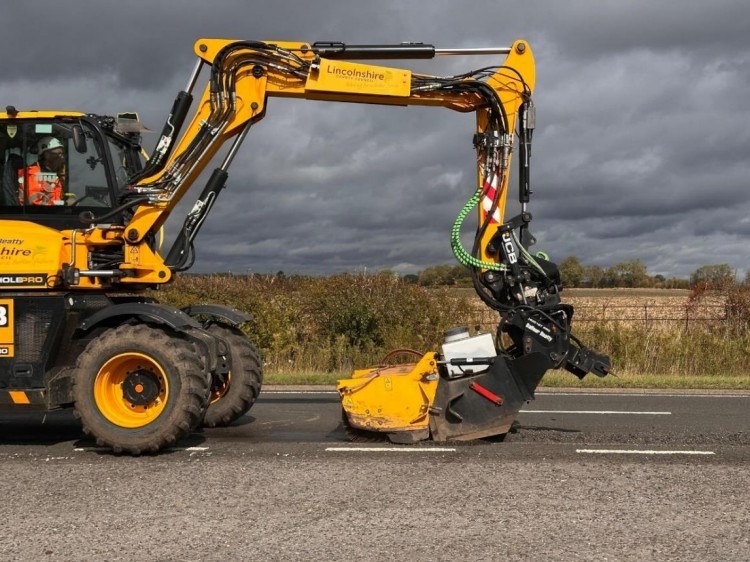
A pothole repair machine will continue to be used to repair Lincolnshire roads after its trial showed it to be a success.
But some councillors have questioned why this trial could not have been done earlier and argue the contractor has been delivering a ‘substandard service’ in the meantime.


The Pothole Pro cuts out sections of road around potholes for neater repairs and aims to work four times quicker than traditional methods, according to its manufacturer, JCB.
In September last year, highways chiefs at Lincolnshire County Council decided to trial the machine for a full year and focused on its ability to repair clusters of potholes and larger patching work (repairing larger sections of roads), as opposed to filling in individual potholes.
Officials have decided to draw the trial to a close eight months on – and said that while the machine is slightly more expensive than conventional methods, it has been very effective at fixing pothole clusters and repairing larger sections of roads.
LCC’s highways contractor, Balfour Beatty, said it will keep the machine ‘on contract’ – meaning it can continue to use it to carry out pothole repairs across the county.
At a meeting on Monday, 27 April, Tom Gifford, client and contract manager at LCC, said: “We’ve had a successful trial. It has operated very well. The level of planning that is required to go into making sure the machine works at its best, I hope, comes through as part of the paper.

“Our provider, Balfour Beatty, has been happy with its operation and it has shown to be a very effective delivery mechanism, in comparison to the standard piece of kit that we’ve been using to deliver this piece of work.
“The machine provides good quality, and the health and safety benefits to the operatives have been significant – and not necessarily what is being measured as part of the trial – but have been demonstrable in the reduction of risk to staff.”
Councillor Thomas Sneath (Reform UK – Holbeach) said: “It is encouraging to see the innovation being trialled properly – with a focus on productivity, safety and value for money, rather than just a novelty factor.

“The fact that the contractor has chosen to retain the machine as part of its normal delivery suggests that the previous trial was inept.
“But following a more mature trial, they are confident of its effectiveness, and I see that this is a positive example of allowing flexibility within the contract to deliver better outcomes for our residents.”
Council officials had previously trialled a Pothole Pro machine in 2021 for just over a month, but it was deemed to be too expensive and did not offer value for money in comparison to the authority’s standard machinery.
Councillor Richard Wright (Conservative – Ruskington) questioned why the trial had delivered different results this time compared to the original trial.
He said: “If we have a contract with anybody, we expect them to deliver the best on the contract, so something does not quite stack up.

“We ended a trial in 2021, we’ve brought it back now. They’ve chosen to keep the machine, it performs so much better, we’re being told – yet at no point in the whole time I’ve been on this scrutiny committee have I heard from the contractor, constantly badgering us to want to bring this machine back into use because it can improve the output.
“Surely, we should have been getting the best output the whole time? Surely, if they knew that this machine could be better utilised, over those years we’ve had a substandard service – and all of a sudden it does better than we previously thought?”
Jonathan Evans, head of highways client at LCC, replied: “I think the big shift with the original trial was that it was doing the normal pothole delivery response.
“Just by making that switch to reactive patching, it means its capacity and need to drive further are reduced instantly.
“With the original trial, just because you’re going out to sometimes a metre square or 0.5 metre square at a location, you will be tracking that machine further.”
Mr Evans went on to say that the council is always working with the contractor to find ways of delivering a better and more efficient service, and the contractor could decide to use a different machine in the future if it proves to deliver better results.
He added: “As a service, we’re always trialling new, innovative ways of delivering the service – always bettering the service – whether that’s a new product, a new treatment or a new material.
“More and more, I think, over this next phase, will be data and AI (artificial intelligence) – how we’re using that and integrating that within the service.”
A council report showed that for the majority of the trial period, the Pothole Pro machine consistently exceeded its target to complete at least 60 metres squared of repairs per day – averaging 64 metres squared per day.
The report also stated that the machine is up to five per cent more efficient at carrying out repairs than the contractor’s conventional pothole-fixing methods.
