
Nottingham city councillors are being advised to support their part of a proposed sand and gravel quarry near Barton in Fabis ahead of a public inquiry, after Nottinghamshire County Council refused permission for the larger part of the site.
A planning report recommends that the city’s planning committee formally states it would have granted permission, subject to conditions, for the section within its boundary.



However, the committee can no longer decide the application. Applicant Land Logical Ltd has appealed against the city council’s failure to reach a decision, alongside an appeal against the county council’s refusal. Both appeals will be considered at a single public inquiry by a planning inspector.
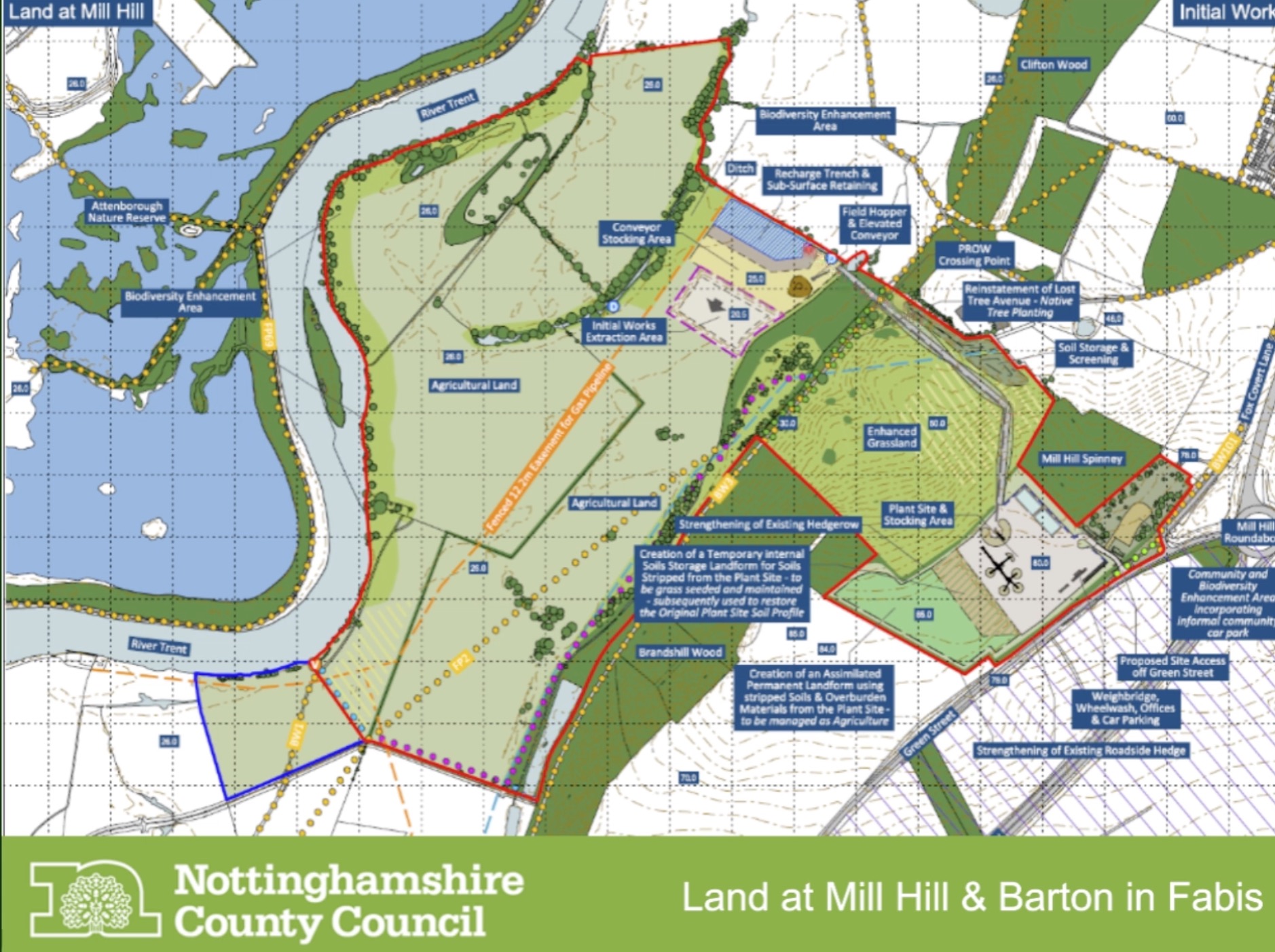
The proposals cover approximately 85 hectares of land off Green Street at Mill Hill and off Chestnut Lane at Barton in Fabis. They would allow the extraction of around 2.55 million tonnes of sand and gravel.
Approximately 10.7 hectares, or 12 per cent of the site, lie within Nottingham city’s boundary. The remaining land falls within Nottinghamshire County Council’s planning jurisdiction.
Extraction would take place over ten years, with site establishment and removal of equipment bringing the anticipated development period to around 12 and a half years. The applicant says restoration would be completed within 15 years, with a proposed 30-year aftercare plan.

westbridgfordwire.com
County councillors refused their application on 16 December 2025, against officers’ advice. They concluded that the conveyor, haul road and associated infrastructure would cause unacceptable landscape and visual impacts, including effects on people using public rights of way.

They also identified uncertainty over ecological impacts, including potential effects on Holme Pit Site of Special Scientific Interest, the loss of parts of Brandshill Grassland and Brandshill Marsh Local Wildlife Sites, and impacts on species including barn owls. The committee considered that the environmental harm was not outweighed by the current need for the quarry.
The city council had informally agreed to consider its application after the county, because most of the site and all access and processing infrastructure would be within the county area. An extension to the city’s decision deadline was agreed until 18 February 2026.
The applicant lodged both appeals on 8 July 2026.
City planning officers say the county’s refusal must be taken into account, but that Nottingham must reach its own judgement about the development within its boundary.
The city land would form the fourth and final extraction phase and contains approximately half a million tonnes of the proposed mineral reserve. No processing plant, conveyor, stockpiles, offices or site access would be located there.
Officers say this distinguishes the city section from the infrastructure criticised in the county’s refusal. However, they also make clear that extraction within the city could not operate independently and would depend on the wider quarry proceeding.
The applications have attracted substantial opposition. Across consultation rounds, the county received approximately 1,333 objections and four letters of support, while the city received approximately 98 objections and one supporting letter.
Concerns include noise, dust, heavy goods vehicles, flood risk, wildlife, the impact on residents at Lark Hill Retirement Village and whether further mineral extraction is needed.
Rushcliffe Borough Council, MPs James Naish and Lilian Greenwood, Nottinghamshire Wildlife Trust and several parish councils were among those opposing the development.
According to the report, the Environment Agency and Natural England raised no objections subject to conditions covering matters including water management, ecological protection and monitoring. City officers conclude that the identified environmental impacts could be managed through enforceable conditions.
The need for the quarry remains a central issue. The report cites an assessment identifying permitted sand and gravel reserves equivalent to 15.47 years of supply across Nottinghamshire, but says further reserves will still be required as existing quarries are worked out.
Officers say the location of supplies also matters, citing evidence that East Leake is the only operational quarry serving the Nottingham area. They conclude that the existing level of reserves does not demonstrate that further provision is unnecessary.
For nearby communities, the proposals would mean quarry traffic using Green Street and the A453. The transport assessment estimates approximately 51 HGV loads a day, equivalent to 102 vehicle movements counting arrivals and departures.
Proposed operating hours are 7am to 6pm from Monday to Friday and 7am to 1pm on Saturdays. The development is expected to provide approximately 16 full-time jobs.
Restoration would progressively create wetland, reedbed, grassland, scrub and open-water habitats, alongside improved public access. The applicant has also agreed to establish a community liaison panel before work begins.
The county portion of the site was allocated for mineral extraction in the Nottinghamshire Minerals Local Plan adopted in March 2021. Earlier applications, submitted in 2017 by a different applicant for approximately 1.85 million tonnes of material, were withdrawn in March 2022 without a decision.
The current applications were submitted in February 2024 and include changes to the extraction area, layout and restoration proposals.
City officers conclude that the benefits of the development within Nottingham’s boundary would outweigh the identified harm, subject to conditions.
The committee is now being asked to establish the council’s position for the appeal and authorise officers to prepare evidence and proposed safeguards. Any final permission and conditions would be determined through the appeal process.
The report also identifies costs to the city council for taking part in the inquiry, including officer time, legal support and specialist advice, but gives no estimate. It does not state an inquiry date.
