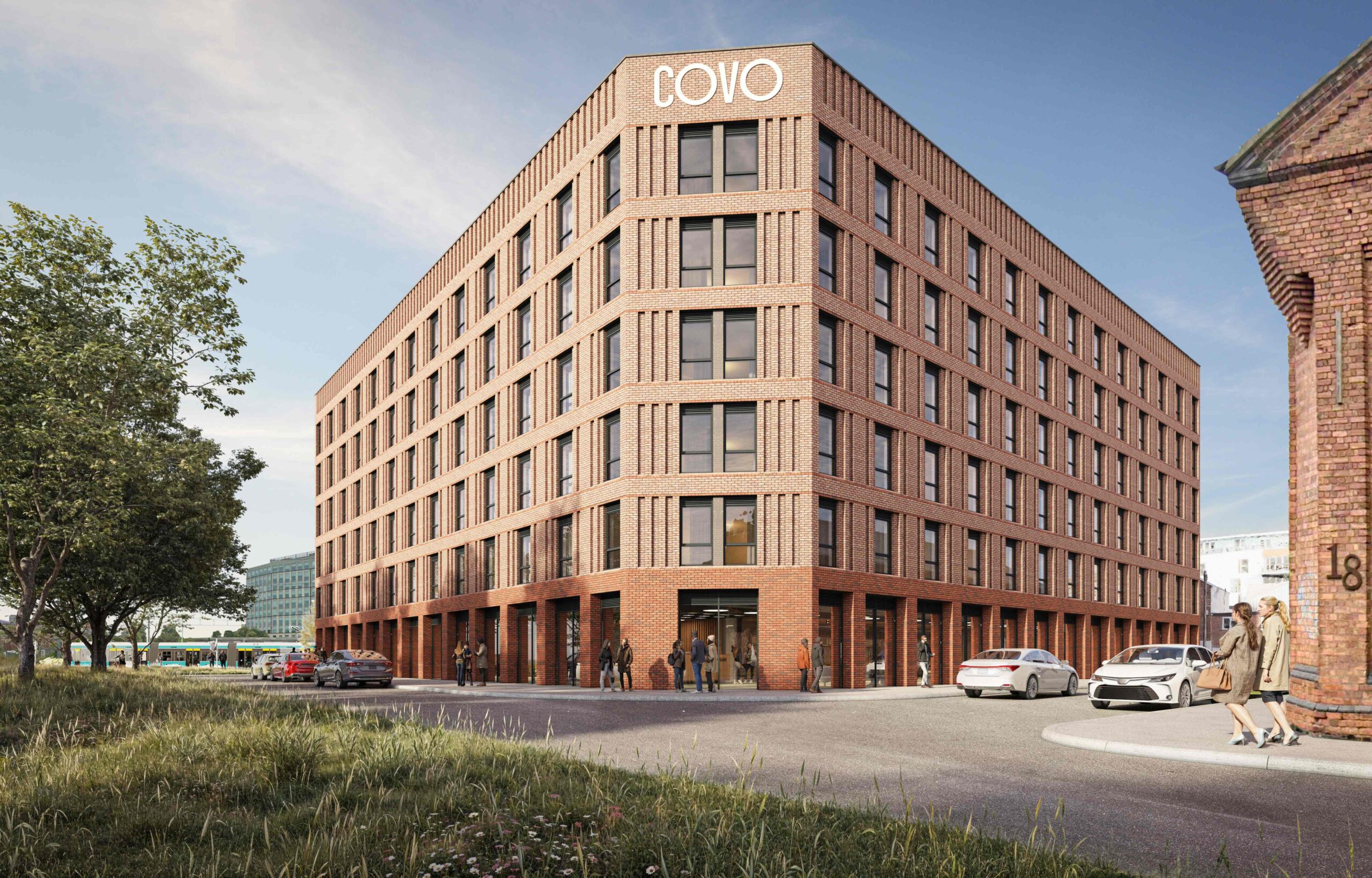
A major plan to build Nottingham’s first co-living apartment block has been given the green light following a lengthy debate over community cash contributions.
The 300-bed development, called Waterway House, will be built off Crocus Street, replacing a vacant 1970s office building.


It will become the city’s first co-living block, whereby its residents live in separate flats but share large amenity areas.
The entire ground floor of the five-storey tower block, as well as some roof areas, will act as communal spaces featuring a gym, padel court, MasterChef-style kitchen area, games and cinema rooms, lounges and co-working zones.
Plans, tabled by Wavensmere, were approved at a planning committee meeting on Wednesday (September 23), but not before the conclusion of lengthy discussions over the lack of information on how much – if any – community cash the developer would be providing.
Fewer and fewer developers are being obligated to provide money for community improvements under what are known as ‘Section 106’ agreements, due to soaring costs in the construction sector.
At the meeting, councillors were asked to approve the scheme without first knowing how much Section 106 money – if any – the developer would contribute.
It prompted councillors Sam Harris (Lab) and Pavlos Kotsonis (Lab) to suggest a way forward that allowed for scrutiny of contributions once the relevant documents had been made available, while simultaneously green-lighting the plans.
However, officers said this was not possible and that this would, in effect, delay a decision on the development.
They said a deferral could prove problematic for the developer on a cost basis, as well as for the council’s performance targets, set by the government to monitor how quickly applications are processed.
Cllr Harris said: “From what I’ve heard, the developer is yet to agree, or come to terms with, what their contribution – if any – will be. That is absolutely fine, but then we are not ready to hear the application.
“Because if they had come to us and said, ‘We actually don’t have a plan for the materials yet, but I’m sure we will find it eventually,’ or, ‘We might have a fourth floor, but we will work it out nearer the time,’ it is just not acceptable.
“I agree it is challenging times. I’m not a nihilist, but I don’t think it is going to get any better. However, we should, as a committee, have a discussion about that.
“I’m just not happy. If we try to hit targets, fantastic, but we cannot hit targets if we haven’t got a whole view of the project.”
Some councillors came to an agreement that plans would be approved, with the final go-ahead delegated to the authority’s director of planning, Paul Seddon.
However, such a delegated decision will only be made upon consultation with the committee’s chair, vice-chair and a member of the opposition, once the relevant documents are published showing what Section 106 contributions will be made.
Financial contributions could range from £3 million to nothing, depending on an independent assessment.
In a statement, Ben Clarke, development director for Wavensmere Homes, had said: “The timely delivery and success of this scheme could propel economic growth for the city.”
He added: “Whilst we are committed to delivering the scheme, the current market presents significant economic challenges stemming from the multi-decade highs of the current UK gilt yields.
“Paired with the reduction in unit numbers, the margin to keep the scheme viable is now incredibly tight.”
The council previously gave permission for developer Rainier to demolish the empty 1970s office and build an eight-storey block of 191 apartments in 2024, but construction work never started.
By Joe Locker, Local Democracy Reporter
