
A woman who was run over by a car towing a caravan when she came off her motorbike in Germany and suffered more than 20 broken bones and other injuries has become the latest ambassador for the country’s first NHS National Rehabilitation Centre (NRC).
Janet Crook-Moore, 58, suffered the near-fatal accident in June last year whilst on a biking holiday through Europe to Sweden with her husband, Roger Moore, and 18 other motorcyclists.


She was put into an induced coma at the roadside and spent seven weeks in a German hospital before she was flown back to NUH’s Queen’s Medical Centre – the closest Major Trauma Centre to her home in Bourne, Lincolnshire.
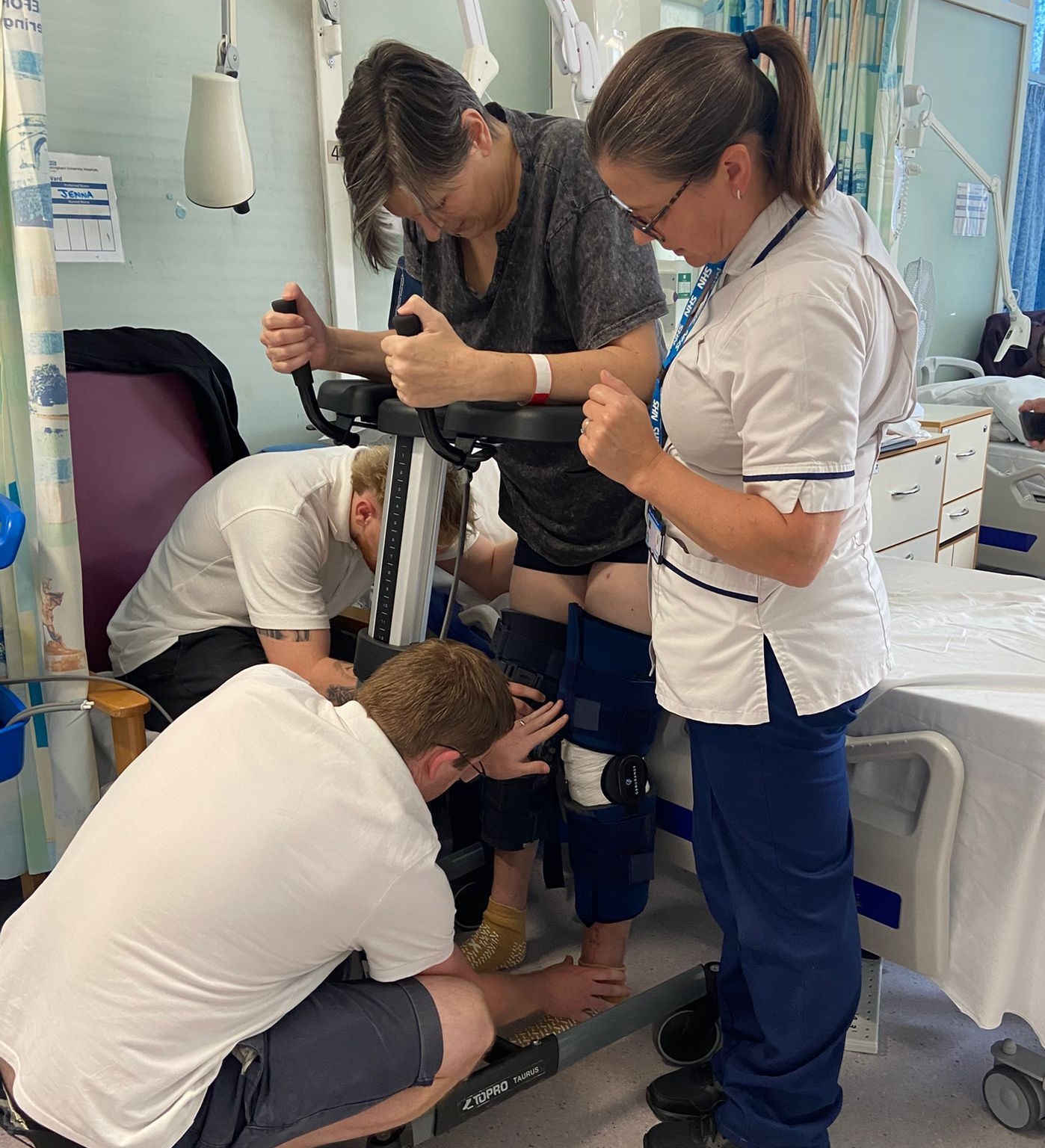
NRC team helping Janet to walk again
It was here that she worked with the NRC team to learn to walk again and became passionate about sharing the importance of rehabilitation. She has therefore become the latest patient ambassador for the NRC.
The NRC is a 70-bed specialist rehabilitation centre for NHS patients who have experienced a life-changing illness or injury, and it will be run and staffed by Nottingham University Hospitals NHS Trust (NUH) when it opens this year.
Janet explained that she has no memory of the accident, but her husband and the other bikers have helped her piece together what happened.
She said: “We were heading towards the ferry from Puttgarden to Denmark. It had been raining, so my back wheel slipped on something and the bike began sliding.
“My bike bounced off the car, and then I went under it. It was a young family on holiday towing a caravan, and thankfully they stopped quickly so the caravan didn’t go over me too.
“It took several people to lift the car off my head.”
Miraculously, the biking group had recently overtaken an ambulance on the motorway, which immediately stopped to help her, as did the police commissioner for the area. Two air ambulances with key medical personnel were also already in the vicinity and were able to get to Janet quickly.
She said: “If it wasn’t for all of those factors, I wouldn’t be here today.
“They put me into an induced coma on the road so that they could move me, and I was taken by air ambulance to hospital.
“I woke up five days later in the Intensive Care Unit with a drain in my lung because I’d punctured one, and I was like the bionic man with cages on my legs. I had broken every limb in my body.
“I must have had some awareness through my subconscious because, when I woke up, no one had to tell me I’d been in a massive accident.”
Janet’s injuries were extensive. She had fractured both collarbones, nine broken ribs, a punctured and collapsed lung, a fractured sternum (chest bone), multiple fractures in her pelvis, a shattered left femur, a broken left fibula (calf bone), a left tibia (shin bone) broken into three pieces, tendon damage to her right knee, a chipped bone in her right wrist, and a fractured scaphoid in her left wrist.
Janet’s leg in a cage device to help the bone grow
Janet said: “One of the doctors said to my husband that I had given Evel Knievel a run for his money.
“They started putting me back together in Germany. I was strapped up and told to lie down, which was hard because, once I’d come round in ITU, I was raring to get up and go!”

Janet had several surgeries over the course of the seven weeks in the German hospital – University Hospital Schleswig-Holstein – including pins and plates in her leg, before her travel insurance company arranged for her to be medically evacuated back to the UK.
She was brought to her nearest Major Trauma Centre – QMC – as she needed extensive treatment, including plastic surgery on her legs.
She was on the C30 Major Trauma Ward for several weeks and began her rehabilitation journey with physiotherapy in bed and by learning to use a slide board to get from the bed to the chair.
However, thanks to Janet’s crash helmet, despite the severity of the accident, she suffered only a split lip and did not sustain a head injury. This became important during her recovery, as complex inpatient rehabilitation has previously only been available for patients requiring neurorehabilitation, something the NRC model is beginning to change.
Janet was therefore transferred to Edward 2 Ward at NUH’s City Hospital, where the NRC model has been piloted, providing intensive rehabilitation to major trauma patients much earlier in their recovery journey.
Janet said: “It was a massive difference from day one – the team are set up to get you up and mobile in a much more intensive way.
“The NRC model is a brilliant idea – you have to engage patients early and get them into the right mindset of moving forward. The patient also has to want to get better and be willing to set goals to help them get to where they want to be.
“We started working on my legs to build up my muscle strength with exercises on the parallel bars, sit-to-stand movements, and getting my hips moving again.
“I was given a frame to walk up and down the gym and ward with, and then the next step was crutches and building up my walking using those. Soon I was ready to walk out of the hospital using crutches and return home.
“It was daunting because I hadn’t seen my house in four months, so it was weird coming home.”
Unfortunately, rehabilitation is rarely straightforward, and Janet has had a couple of infections since initially going home, which has meant spending further time in hospital and on rehabilitation wards.
In addition, the Orthopaedic team at NUH have been able to help Janet regrow the 4.5 cm of her tibia (shin) bone that had died, with approximately half a millimetre growing each day. This surgical technique uses the body’s natural healing process to grow new bone and surrounding soft tissue by dividing the bone, installing a wire frame, and gradually moving the bone apart, which encourages the regeneration of new bone to fill the gap.
Janet explained that, because the new bone is fragile and like candyfloss, she is currently limited in how much weight it can bear. She therefore still has to use crutches at home and a wheelchair when out of the house, but she continues to enjoy days out.
Mr Andrew Taylor, Consultant Orthopaedic Surgeon and Medical Lead for the NRC, explained that Janet had extensive injuries when she arrived at NUH, but that she has clearly benefited from intensive rehabilitation.
He said: “Janet is unusual due to the number of severe, life-changing injuries that she sustained.
“Thanks to the NRC model, we were able to provide her with intensive support from our rehabilitation team, something that just isn’t possible on a trauma admissions ward.
“Not only were we working to heal the individual injuries, but also, more holistically, to address her severe deconditioning, which is one of the main aims of the NRC and rarely happens elsewhere in the UK.
“Together, we were able to get Janet back to independent living and enjoying life, and we continue to support her towards returning to work independently.”
In the long term, Janet plans to return to her job as a Quality Manager in a laboratory and is determined to return to her independent life, visit the NRC, and encourage patients as soon as possible.
