
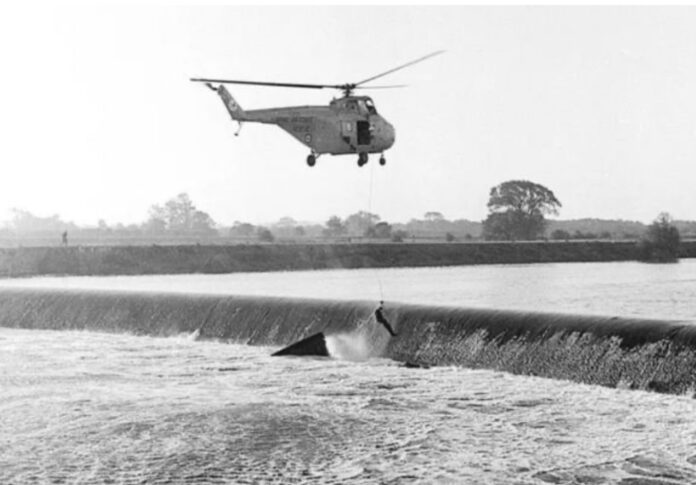
Fifty years on from a river tragedy that claimed the lives of ten young soldiers, a retired police officer has recalled how he and three colleagues battled in a rowing boat to save the men – adding “we did our very best… no-one could have done more”.
The Cromwell Weir tragedy happened on September 28, 1975, when a Royal Engineers assault boat on a night-time exercise went over Cromwell Weir on the River Trent, killing all but one of those on board.
It was, and remains the largest peacetime loss of life for the military.
Cromwell Lock and Weir is a huge concrete engineered construction marking the tidal point of the River Trent.
An apparent power failure at the weir caused its navigation lights to go out, and the boat, carrying members of 300 Troop of 131 Parachute Squadron, capsized in reportedly stormy, dark conditions, leading to the tragic deaths of the young soldiers.


Sapper Pat Harkin, the sole survivor, who was rescued by local Newark police officers.
A memorial service to mark the 50th anniversary of the tragedy will take place at the lock, near Newark, today (Sunday).
PC David Scott, PC Albert Walker and PC Mick Bostock were the three constables who initially attended the scene, along with their Sergeant Dave Goodwin.
Recalling the emergency response, 70-year-old David – now a retired Inspector living in Cornwall – said: “It was so dark. We hadn’t seen the faces of the electricity men working there, but gathered from their confusing explanations that ‘a boat’ had gone over the weir, and that many shouts for help had reduced to one voice.
“We assumed that it was a houseboat, or a pleasure craft. Sergeant Goodwin found a row boat in the lock secured with a chain and the electricity men cut its chain and we climbed down the many rungs of the deep dark lock that sat next to the weir, and took the boat away from the side.
“We went out of the lock and turned a hard right, into the thunderous roar and spray below the weir. Dave rowed us towards the sound of the voice that was shouting for help, but down at water level it was very difficult to hear anything.
“We lost contact with everybody else. The noise, spray, turbulence and darkness closed everything else off from us. We had no idea what was going on. It was noisy, it was wet and it was terrifying as the weir grew closer and loomed over us cutting out all other scenery and almost any light.”
 Retired police officer David Scott was aged 20 when he attended the rescue mission
The officers reached the centre of the river and stopped about ten feet away from the bottom of the torrent when the shape of a boat hull came into view.
“Our torches showed that there were people attached to it by ropes,” recalled David. “I didn’t know if they were alive or dead. A moment later the boat, and the people, were sucked away again.
“Then another body – or bodies – appeared, just to be sucked away again as the boat they were attached to continued its cycle in the turbulence.
“We found penknives and I leaned over the back and started trying to blow air into mouths presented to me whilst cutting the ropes securing them – and I could see that the first was a young man, my age – they were all young men, my age – ginger haired and white, so very, very white skinned.
“They were all unshaved and their whiskers were sharp on my face as I tried to blow air into them – which is a strange thing to recall so clearly.”

The conditions on the night of the exercise were worsened by a high tide, making the situation more dangerous.
David added: “Every orifice – mouths, eye sockets, nose and ears were filled with water. Sgt Goodwin used the oars and did his best to hold our position, with the pointy end downstream and me under the torrent, and we tried not be pulled in ourselves but our little boat quickly swamped. There were too many times when the beating of gallons of water on the back of my head was intolerable, but we continued.
“We must have succeeded in cutting some of the ropes, because bodies were later found downstream, but we had no idea at the time, just grabbing collars, hair, belts, ropes – anything to bring the faces to us before they were taken again for another cycle.
“We managed to get one man alive, and one body, into our boat, but it was so confusing and noisy; and we continued our labours as best we could, with that one desperate focus.”
David said he and his colleagues did everything they could to try and save lives that night and that the following weeks and months were challenging for a myriad of reasons.

He said: “Our roles in the rescue and recovery, evidence gathering, containing and controlling, counselling and consoling meant that the job we played as police officers was extremely stressful, albeit eclipsed by the tragedy of it all.
“At first there was a stand-off between the Army and the Chief Superintendent over whom should investigate and report. The military had much to hide in terms of poor equipment, poor supervision and drink – but an accommodation was found giving the police primacy, but it was never a comfortable fit – and this resulted in the ‘Open’ verdict at the inquest.
“It was a horrendous time for everyone concerned. The four tray mortuary at the old Newark Hospital was overwhelmed, as was the retired GP who carried out routine post-mortems.
“Large family groups came down by train from Glasgow and were understandingly very demanding of answers. Some families had to wait three days for the body of their loved one to be found and even went out searching themselves.”
The Inquest verdicts were left ‘open’ recording that all the men died by drowning.
