

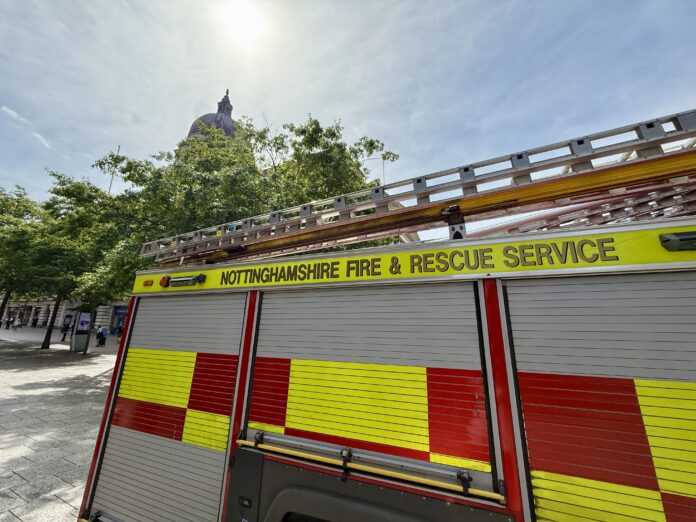
Fire crews across Nottingham and Nottinghamshire were called out to significantly more incidents over the summer as a combination of hot, dry weather and rising demand placed increased pressure on resources, according to a performance update due to be scrutinised by councillors next week.
A report ahead of the Nottinghamshire and City of Nottingham Fire and Rescue Authority’s Community Safety Committee meeting on 9 January 2026, sets out how the Service performed between 1 July and 30 September 2025, the second quarter of the 2025/26 financial year, covering its prevention, protection and emergency response duties across the city and county.
During the three-month period, Nottinghamshire Fire and Rescue Service attended 3,374 incidents, a rise of almost 17 per cent compared with the same quarter last year and a continuation of the upward trend seen earlier in the year. This followed a sharp increase in Quarter One and reflects what senior officers describe as sustained operational pressure rather than a short-term spike.
The increase was driven primarily by a sharp rise in fires, which were up by 43 per cent year-on-year. Both deliberate and accidental fires rose significantly, a pattern the Service attributes largely to prolonged hot and dry conditions during July and August, when vegetation and outdoor fires became more frequent across both urban fringes and rural areas. Special service calls, which include incidents such as flooding, animal rescues and road traffic collisions, also rose by 14 per cent, while false alarms increased more modestly by two per cent.
For the first time since the heatwave of August 2022, fires outnumbered false alarms during parts of the quarter, particularly between April and August, before returning to more typical seasonal levels in September. Over the last year as a whole, false alarms and special service calls have averaged 436 and 254 incidents per month respectively.




Geographically, the City of Nottingham continued to account for the highest volume of incidents during the quarter, with 996 call-outs, while Rushcliffe recorded the lowest number at 252. Other districts, including Ashfield, Bassetlaw, Broxtowe, Gedling, Mansfield and Newark and Sherwood, all experienced elevated demand compared with previous years, reflecting a broadly county-wide pattern rather than isolated pressure points.
When incidents were broken down by severity, the largest increase was seen in lower-risk Priority 3 incidents, which rose by more than 18 per cent compared with the same quarter last year. These incidents, while less likely to pose an immediate threat to life, still require resources and are consistent with the types of fires and outdoor incidents associated with dry summer conditions. By contrast, the most serious Priority 1 incidents, which involve an immediate risk to life, fell by around 4.5 per cent.
Response times were affected by the surge in activity. The Service’s Community Risk Management Plan sets a target for emergency incidents to be attended, on average, within eight minutes of the first appliance being mobilised. During the quarter, the average attendance time was eight minutes and 22 seconds, 19 seconds slower than the same period last year and just outside the target.
Senior officers say this was largely due to the volume and spread of incidents, particularly in rural areas, which required crews to travel further from their usual station ground. Mapping of Priority 3 fires shows a wider geographical distribution than in previous years, increasing travel times and placing additional strain on available appliances.
Despite this, both wholetime and on-call crews met or exceeded their station turnout targets. Wholetime crews mobilised slightly quicker than their target time, while on-call crews improved their average turnout by 12 seconds compared with the required standard. Without this performance at station level, the report notes, overall attendance times would have been worse.
On-call availability remains a challenge, particularly following the introduction of a new dual employment policy in April 2024. The policy was designed to ensure compliance with working time regulations for staff who serve both as wholetime and on-call firefighters, but it has had an anticipated impact on on-call availability.
During the quarter, on-call stations were available on average 80.7 per cent of the time, below the Service’s 85 per cent target and down from 82.9 per cent in the same period last year. However, this remains well above the most recent national average of 66 per cent across England. Fourteen of the Service’s sixteen on-call sections exceeded the national figure, with Warsop providing full 24-hour availability throughout the quarter. Harworth and Southwell were the only stations to fall below the national average.
Wholetime appliances were available 97.3 per cent of the time, just below the 98 per cent target, reflecting a combination of mechanical issues, training requirements and staffing pressures linked to sickness absence. Special appliances, such as aerial ladder platforms and specialist rescue units, exceeded their availability target, remaining operational more than 98 per cent of the time.
Performance at Joint Fire Control, which handles emergency calls and mobilisation in collaboration with Derbyshire Fire and Rescue Service, remained strong despite the increase in incidents. More than 96 per cent of emergency calls were answered within seven seconds, matching the best performance recorded in the last two years. Average call-handling times for the most serious incidents were also well within target, at 68 seconds compared with an 86-second benchmark.
The reliability of the mobilisation system improved compared with earlier in the year but narrowly missed its 99 per cent availability target, recording 98.6 per cent uptime during the quarter.
The report also highlights the impact of changes to how incidents at prisons are handled. Following a trial introduced in August 2024, the Service moved away from a standard response of three appliances and an officer to all prison incidents, instead tailoring attendance based on the nature of the call. The change was informed by the presence of trained prison staff, built-in fire safety features and continuous monitoring within prison estates.
Since the revised approach was adopted, appliance mobilisations to prisons have fallen sharply, with a 50 per cent reduction during the trial period and no adverse safety outcomes reported. The data shows that while incident numbers fluctuated, the number of appliances sent continued to fall, freeing up resources for other emergencies.
Preventative work continued at pace during the quarter. Crews completed 4,586 Safe and Well visits, keeping the Service on track to meet its annual target of 16,000 visits. This equates to almost four visits per 1,000 residents, around 56 per cent above the national average. More than half of visits were to people aged over 65, while 43 per cent were to people who identified as having a disability, reflecting the Service’s risk-based approach.
Use of the Safelincs online self-referral system increased again, with 361 people requesting a visit for themselves or others, up from 279 in the previous quarter. All qualifying serious incidents were subject to formal review, with follow-up reassurance and engagement activity delivered in affected communities.
In fire protection, the Service completed 308 fire safety audits during the quarter and remains on course to meet its revised annual target. It continues to operate well above national inspection rates, with significantly higher audit activity per premises than the England average. Enforcement activity also remained robust, with prohibition notices continuing an upward trend compared with previous years.
The report sets this operational picture against a backdrop of wider national reform following the Grenfell Tower fire, including the introduction of the Building Safety Regulator under the Building Safety Act and new responsibilities around high-risk buildings. Nottinghamshire Fire and Rescue Service is actively supporting this work through regional inspection teams and engagement with the East Midlands Combined County Authority on remediation acceleration plans, which aim to identify and address unsafe cladding in taller residential buildings by the end of the decade.