
Historic England has today (Thursday 6 November 2025) revealed its Heritage at Risk Register 2025.
The Register gives an annual snapshot of the health of England’s valued historic buildings and places. It helps to ensure they can be protected and continue to be enjoyed in the future.
Heritage plays a vital role in the pride people feel about their local place. It gives meaning to the places where people live, work and spend time, connects us, inspires creativity, and boosts economic growth. When it’s not looked after and used, communities feel a sense of decline.
Sites that have now been brought back into use and saved include: Papplewick Pumping Station in Nottingham following a major £500,000 restoration project and Taylor’s Bellfoundry in Leicestershire following repairs and improvement works to the tower, although part of the site remains at risk.
Other sites saved include Bradgate Chapel in Leicestershire following Historic England funded repairs to the masonry and the plaster ceiling. Repairs have also been made to the exterior and interior of Grove Street Methodist Church in Retford following a Historic England grant and major fundraising effort. Its oval gallery now provides a magnificent auditorium that’s used by both the church and local community.


Historic England works together with partners and communities in inventive ways to breathe new life and hope into places that need it most. We want to see ‘at risk’ historic buildings brought back into productive use so they can be enjoyed by local communities and contribute to the local economy.
This year alone, nine sites in the East Midlands have been rescued and their futures secured. Many buildings and sites have been rescued with the help and commitment of local people, communities, charities, owners and funders including The National Lottery Heritage Fund.
Given the environmental impact of demolishing buildings and replacing them, the greenest building is the one that already exists.
Historic England is harnessing the power of heritage for the planet, contributing to achieving net zero carbon emissions by facilitating the adaption and reuse of historic buildings.
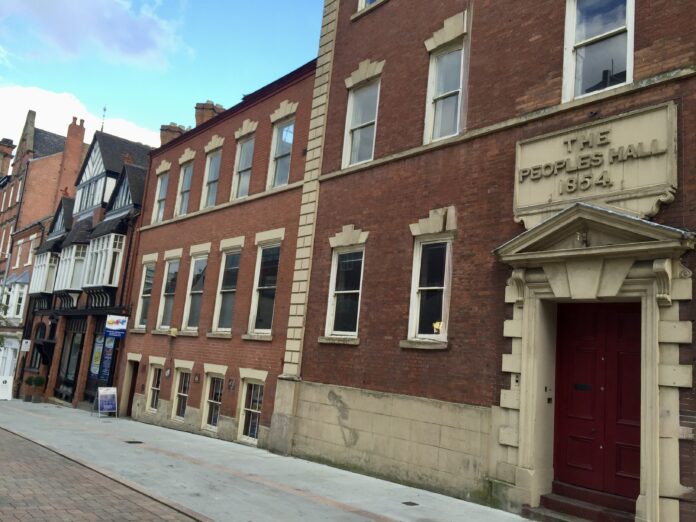
There are also more buildings and places which need help. The pair of cottages, Buildings 26 and 21 at Cromford Mills in Derbyshire have been added to the Register this year because of their poor condition; St Peter’s Church in Bassetlaw, Nottinghamshire has been added because the rare murals are at significant risk of loss and damage due to water penetration; and thePeople’s Hall in Nottingham is newly at risk due to urgent fabric repairs being needed and high level water damage. See fuller list below.
In total, 17 historic buildings and sites in the East Midlands have been added to the Register this year because they are at risk of neglect, decay or inappropriate development.
Claudia Kenyatta CBE and Emma Squire CBE, Co-CEOs of Historic England, said: “The heritage we see all around us impacts how we feel about our local places. The annual Heritage at Risk Register gives us the opportunity to celebrate the many benefits of bringing our historic buildings back into use.
“The best way to protect our buildings is to reuse them, turning them into places of local connection and joy. The sites that have been saved and have come off the Register this year really highlight the benefits of working together in partnership, and with communities, to create positive, sustainable change. Together we can safeguard our heritage for future generations.”
Heritage Minister Baroness Twycross said: “We are determined to protect the heritage at the heart of our communities. It is fantastic to see so many historical sites saved for communities up and down the country. These are much loved places and it is great to see them being brought back in to use. This year alone our £15 million Heritage at Risk Capital Fund has been key to saving buildings like these.”
BUILDINGS AND SITES SAVED IN THE EAST MIDLANDS INCLUDE:
SAVED: Taylor’s Bellfoundry (on west side of Cobden Street), Loughborough, Leicestershire LE11 5AJ (Grade II*)
Loughborough bellfoundry rings around the world – Part of the site remains at risk
Taylor’s Bellfoundry is the largest purpose-built bellfoundry in the UK still in use. Constructed in 1859, it is an example of the specialised metal working industry that thrived during the 19th century. Thousands of church bells have been made here over the years, including the 17-tonne ‘Great Paul’ for St Paul’s Cathedral in London. Taylor’s bells can also be found around the world, including in St. Andrew’s Cathedral in Sydney and St. Thomas’s Church in New York.
Following a series of Historic England repair grants, Taylor’s Bellfoundry secured funding from the National Lottery Heritage Fund for significant repair and improvement work to the tower. These repairs were completed in 2024 and have enabled one of the two sites collectively known as Taylor’s Bellfoundry to be removed from the Heritage at Risk Register this year.
Further repairs are required to the foundry building on the east side of Cobden Street which remains on the Register.
Andrew Wilby, Chairman and CEO of Taylor Bells & Co said: “Taylor’s Bellfoundry is the country’s last living link between tradition and innovation in bell making today. We are pleased part of the foundry is being removed from the Heritage at Risk Register and look forward to working with Historic England and partners to ensure the site can be restored to its former glory.”
SAVED: Papplewick Pumping Station, Rigg Lane, Ravenshead, Nottingham
Victorian engineering marvel removed from the Heritage at Risk Register
A major £500,000 restoration project has been completed at Papplewick Pumping Station allowing it to be removed from the Heritage at Risk Register.
The ornate pumping station, built between 1882-86 in the Gothic Revival style, provided clean water to Nottingham until it was decommissioned in 1969. It remains the only pumping station in England to still have all its original features, including machinery and the reservoir.
The Grade II* listed Engine House has stunning interiors, with images of fish and water lilies decorating tiles and stained-glass windows. These features are remarkable given the station was rarely visited by anyone other than workers.
Historic England’s grant of £9,450 in 2021 helped identify repair needs and inform a successful £518,000 grant from Arts Council England’s Museum Estate and Development Fund (MEND) in early 2023.
Repair works to the Boiler House’s chimney, the Engine House porch and the listed flanking walls were completed last winter.
SAVED: Bradgate Chapel, Bradgate House Newtown Linford, Leicestershire (Scheduled Monument / Grade II*)
Bradgate House was the family seat of Lady Jane Grey, the nine-day Queen of England who was born here in 1537. The mansion was begun by Henry Grey, third Marquess of Dorset in 1532 and completed in the early 1550s, with additions made in the 1600s.
The ruins of the house survive well and, together with a formal garden and watermill site, it is an important medieval complex. The site was added to the Heritage at Risk Register in 2022 due to structural concerns. In 2023 Historic England awarded a grant of over £37,000 to the Bradgate Park Trust towards work to inform wider repair needs. This included an assessment of a rare wall painting which survives above the chapel ceiling – the only roofed structure of the complex.
The Trust has recently been awarded a Countryside Stewardship grant for the repair of the extensive ruined remains of the house and related structures.
Over the past two years, Historic England has funded the repair of Bradgate Chapel including the plaster ceiling, the large west window and external brick, stone and mortar repairs. The monument to Henry Grey, first Baron Grey of Groby, and his wife Anne was also cleaned and repaired.
James Dymond, Director of the Bradgate Park Trust said: “Bradgate House is one of the key attractions within the park, due to its connection to Lady Jane Grey. We’re delighted with the work that Historic England and other funding has enabled over the past year. We are especially pleased that Bradgate Chapel is no longer at risk and can be enjoyed by visitors again.”
SAVED: Methodist Church, 65 Grove St, Retford DN22 6LA (Grade II)
Church repaired following major fundraising effort and Historic England grant
Methodist Church, Grove Street is a Grade II listed classical-style brick and stone building built by architects Bellamy and Hardy in 1880. In 2014, plaster and structural failure of the ornate original ceiling led to the closure of the main worship area and its inclusion on the Heritage at Risk Register.
The ceiling was repaired in 2021 and fundraising by the church ensured that by 2025 repairs to the external stonework and the internal towers, the redecoration of the sanctuary, and the installation of new heating and audio-visual systems were completed. The high-quality interior with its oval gallery provides a magnificent auditorium that is used by both the church and the wider community.
Reverend Julie Coates, Superintendent Minister, Trinity Methodist Circuit (Retford and Worksop) said” We are blessed with a beautiful, historic building and are delighted to see it coming alive with purpose every day of the week. Our vision is to continue to use this sacred space both for the worship of God and to serve the needs of our local community.”
BUILDINGS THAT HAVE MADE PROGRESS IN THE EAST MIDLANDS:
Good Progress: Building 18, Cromford Mills, Mill Lane, Cromford, Matlock DE4 3RQ (Grade I)
Building 18 is the first mill built by Richard Arkwright at Cromford Mills in the 1770s which revolutionised cotton spinning across the globe. It is of great historic significance but has been affected by structural problems and heritage crime, including fires and vandalism.
Building 18 was added to Historic England’s Heritage at Risk Register in 1998 due to its very poor condition. Its asbestos roof was partly replaced with cement fibre sheets 25 or so years ago. By 2021, roof coverings were no longer weathertight, guttering was problematic and there were structural concerns.
Historic England awarded a grant of around £29,000 for detailed project development work in 2021. This work, which included surveys and structural investigations was completed in 2023.
Historic England awarded further funds in the region of £340,000 later in 2023 for replacement roof coverings, environmental cleaning, structural repairs and drainage improvements. The Pilgrim Trust awarded a grant of £30,000 towards these works and a contribution from the Headley Trust towards the drainage proposals. The works completed this summer.
Building 18 can now play a part in the ongoing regeneration of Cromford Mills, and in turn the conservation and presentation of the UNESCO Derwent Valley Mills World Heritage Site.
Eilis Scott, Chief Executive Officer of the Arkwright Society said: “We are delighted to have received vital and timely support from Historic England for the interim repair works to Building 18, the First Mill. It is Cromford Mills’ most historically significant structure and a landmark within the Derwent Valley Mills World Heritage Site. Their funding and expert guidance with support from The Pilgrim Trust has enabled us to secure a temporary roof, keeping the building wind and weather tight.”
SITES AT RISK AND ADDED TO THE REGISTER IN THE EAST MIDLANDS INCLUDE:
ADDED: Buildings 26 And 21 At Cromford Mills, Mill Lane, Cromford, Matlock
Cromford Mills in Derbyshire’s Derwent Valley World Heritage Site is the home of the factory system of production. It was at Cromford in the 1770s that Richard Arkwright harnessed waterpower to drive his ‘water frame’ cotton spinning machines. He built 14 mill buildings and created an early industrial community, the forerunner not only of the textile mills and mill towns of the Midlands and North of Britain, but across the world.
Newly at risk are Buildings 26 and 21. A pair of cottages constructed in around 1780, perhaps to house mill workers on call.
In around 1921, Cromford Colour Works established a dying plant on the site and produced pigments for paints and dyes. In 1924, Building 26 was purchased (then let) by W H Bently and named ‘Grace Cottage’ after one of his daughters.
After 50 years, Cromford Colour Works abandoned the site, and it was put up for sale in 1979. Cromford Mills, which by this time included many buildings contaminated by lead chromate, was purchased by The Arkwright Society which is bringing them back into use. The site is now a popular visitor attraction. Building 26 is not in use and Building 21 is used for archival storage.
Buildings 26 and 21 have been added to the Heritage at Risk Register because they are in very poor condition. Historic England has awarded a grant of around £25,000 for project development work which will include surveys and a feasibility study of potential sustainable new uses.
AT RISK: St Peter’s Church Town Street, Clayworth, Bassetlaw, Nottinghamshire DN22 9AB (Grade I)
Rare murals at risk of loss in this 11th century church
This 11th century church in the village of Clayworth, on the Old Roman Road that ran between Doncaster and Lincoln, features rare murals on the four chancel walls painted by acclaimed Scottish artist Phoebe Anna Traquair in 1904-1905.
St Peter’s Church has been added to the Heritage at Risk Register 2025 because the murals are at significant risk of loss and damage due to water ingress on the north wall, poor environmental conditions, condensation, and the impact of soluble salts breaking down the plaster and paint.
The paintings are significant. They were the artist’s first work outside of Scotland, and she only completed one other commission in England. This major installation was commissioned as an act of thanksgiving by an important local figure for the safe return of their son from the Boer War.
Davina Gull, member of the Clayworth Church PCC said: “These unique murals depicting biblical scenes are in urgent need of specialist restoration to prevent further loss of detailed artwork and to preserve them for future generations. We are applying for a National Lottery Heritage Fund grant to fund this essential work and would greatly appreciate donations to help us restore these beautiful paintings.”
AT RISK: People’s Hall, 18 Heathcote Street Nottingham NG1 3AA (Grade II*)
Community space designed for the people ‘at risk’
Morley House was built or possibly rebuilt in 1750 for a family of potters and brickmakers, one of several houses erected around this time in fashionable Nottingham. Not as grand as some, but with a good staircase and surviving features, it was bought by a local businessman in 1854. He converted it into a temperance centre which he called ‘People’s Hall’.
It suffered from road-widening, depriving it of its forecourt and the magnificent wrought-iron gates are now next door. However, it remains an important part of Nottingham’s story.
It was added to the Heritage at Risk Register this year due to urgent fabric repairs and high-level water damage. Plans are afoot to bring the building back into community use and continue its longstanding history of being a place for the people.
Toby Ebbs, Chair of the Nottingham Historic Building Trust said: “The Nottingham Historic Building Trust (NHBT) are currently undertaking a feasibility study to determine the most viable end-use for the building. The owner has provisionally offered a 20-year rent free lease to the NHBT if funding can be secured to meet the conservation deficit. There is so much potential in the end-use possibilities, with a high level of interest at a community and local level.”
