
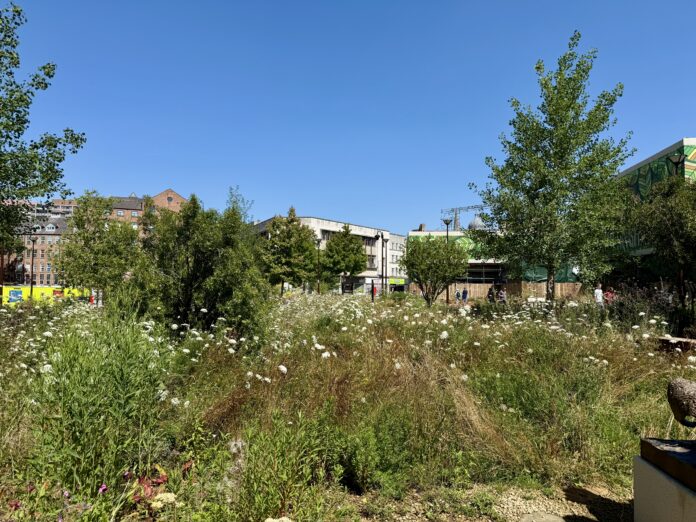
Nottingham City Council says its long-term approach to parks and open spaces is beginning to reshape how green infrastructure is planned, funded and managed across the city, one year after the formal adoption of its Greener, Healthier, Happier Nottingham Greenspace Strategy.
The update will be presented to the council’s People, Communities and Environment Scrutiny Committee in January – which had requested a detailed review of progress since the strategy was adopted in October 2024 following several years of development and consultation.
The strategy emerged from work carried out under the national Future Parks Accelerator programme, funded by the National Trust and National Lottery Heritage Fund, at a time when councils across the country were reassessing how parks could be sustained amid financial pressures, rising maintenance costs and growing expectations around climate resilience, biodiversity and public health. Nottingham declared a climate and ecological emergency in 2019, and the greenspace strategy was subsequently designed to act as a delivery mechanism for that commitment while also addressing inequalities in access to high-quality open space across the city.
Council officers say the strategy has now been embedded across a wide range of policy areas rather than operating as a standalone parks document. It is aligned with the council’s Carbon Neutral 2028 charter and the associated 250-point climate action plan, and it is being used to guide the delivery of Biodiversity Net Gain requirements introduced under the Environment Act. The approach also links directly to public health policy, including the council’s Eating and Moving for Good Health strategy, with green infrastructure increasingly framed as a preventative health measure rather than an optional amenity.
In practical terms, the council reports that the four core themes of the strategy – greener connected neighbourhoods, climate-positive spaces, activated and healthy places, and nature-rich spaces for people – are now shaping investment decisions and project design. Examples cited include the Green Heart development on the former Broadmarsh site, which has converted part of the city centre into a nature-rich public space with planting, play facilities and water features designed to reduce surface water flood risk, and the restoration of the Victoria Embankment Memorial Gardens and paddling pool, supported by more than £1.25 million in National Lottery Heritage Fund grant funding.


The report highlights a shift towards targeting resources using population data and the Index of Multiple Deprivation, with the aim of prioritising wards where residents have poorer access to green space and worse health outcomes. The council says this is intended to address long-standing inequalities between neighbourhoods, rather than concentrating improvements in already well-served areas.
Partnership working features heavily in the first-year review. Nottingham City Council is working with organisations including Nottinghamshire Wildlife Trust, the Canal & River Trust, Natural England, the Environment Agency and the Nottingham Open Spaces Forum, alongside community groups and social enterprises. Projects such as Greening Sneinton, which installed sustainable drainage planters outside Sneinton Market to reduce flood risk while improving the street environment, are being cited as models that could be replicated elsewhere in the city.
Volunteer involvement has also expanded, with the council’s Green Guardians programme now involving more than 440 volunteers and supporting activities ranging from tree planting to habitat management. Officers report that more than 50,000 trees have been planted through the programme over the past five years, including the creation of small “Miyawaki” woodland areas, and that volunteering is now being treated as a core element of service delivery rather than an add-on.
However, the review acknowledges significant challenges. Funding pressures and staffing capacity remain ongoing concerns, despite a recent service redesign that created ten additional posts to strengthen delivery. The council is drawing on a mix of Section 106 developer contributions, UK Shared Prosperity Fund allocations, public health budgets and external grants, but officers warn that demand continues to outstrip available resources. To address this, a more formal prioritisation framework is being developed to determine where investment will have the greatest impact.
Long-term maintenance is another issue highlighted by scrutiny members, with the council stressing the importance of designing new schemes in a way that avoids creating future liabilities. Maintenance plans are increasingly being built into projects from the outset, alongside greater involvement from community groups and exploration of social enterprise models to help sustain improvements over time.
The report also outlines how progress is being monitored. Governance arrangements include the Local Nature Recovery Strategy partnership, the Nottingham Open Spaces Forum, and internal groups such as the Grey to Green Taskforce, which brings together highways, flood risk and greenspace teams to coordinate climate-resilient planting and drainage schemes. Individual projects are assessed against agreed outcomes including biodiversity, accessibility and community engagement, while resident feedback is captured through mechanisms such as the council’s “Have Your Say” platform, service reporting systems and nationally benchmarked customer satisfaction surveys.
Councillors were told that Nottingham is now sharing its approach nationally through programmes such as Nature Towns and Cities and professional networks including APSE and the Midlands Parks Forum, while also learning from other cities. Work is under way on a potential habitat banking model that could allow the council to sell off-site biodiversity units to developers, creating a new income stream to fund nature recovery projects.
The council argues that the cumulative impact of the strategy is already visible in improved parks, increased volunteering, new funding secured for heritage and play facilities, and growing national recognition for the city’s approach to urban greening. Scrutiny members will now use the one-year review to assess whether the strategy is delivering tangible benefits for residents and to inform future priorities as Nottingham continues to balance environmental ambition with financial reality.
