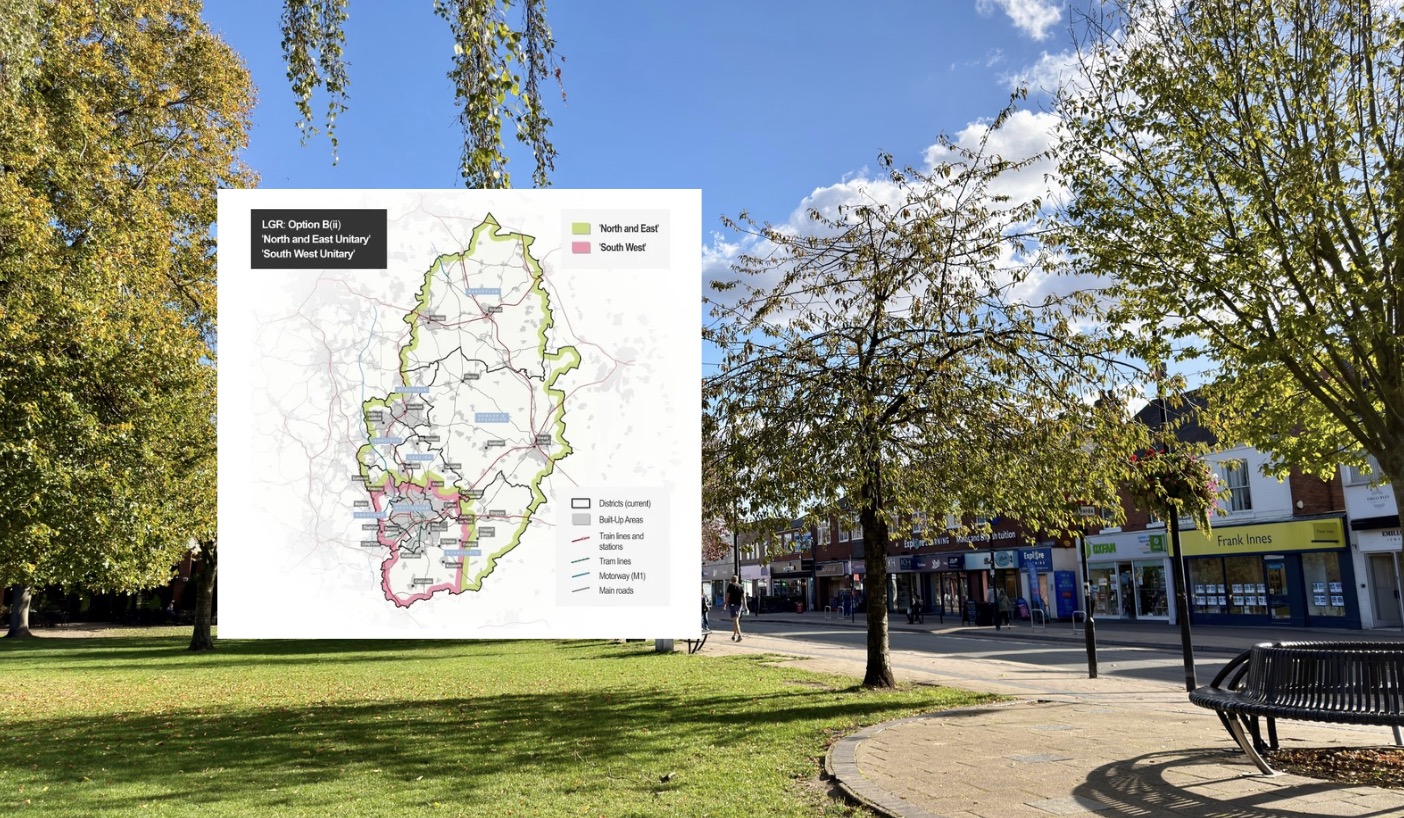
Nottingham City Council will meet on 10 November 2025 to debate a major reorganisation of local government that could alter the way services are delivered across Nottinghamshire and redraw the boundaries between the city and its neighbouring boroughs — including Rushcliffe and West Bridgford.
The full council discussion will inform the Executive Board’s final decision on 25 November before the authority submits its formal proposal to the government by the end of the month. Ministers have asked all councils in Nottinghamshire to bring forward plans for unitary local government, replacing the current two-tier system with larger single-tier authorities.


The move follows the Government’s English Devolution White Paper and the English Devolution and Community Empowerment Bill, which set out a national timetable for creating new unitary councils across England by 2026 as part of wider devolution and efficiency reforms. Nottingham and Nottinghamshire are among 21 areas invited to produce a plan.
Nine councils currently serve the county — the City Council, Nottinghamshire County Council and seven district or borough authorities, including Rushcliffe, Gedling, Broxtowe, Mansfield, Ashfield, Newark & Sherwood, and Bassetlaw. Together they cover more than 1.1 million residents.
Three structural options were first identified by an independent appraisal from consultants PwC earlier this year. Option 1b would merge Broxtowe, Gedling and Nottingham City into one unitary authority, with a second unitary covering the rest of the county, including Rushcliffe. Option 1e would combine Broxtowe, Nottingham City and Rushcliffe, leaving the northern and eastern districts together. Option 2 would leave the City as it is and create one county-wide unitary — but this latter choice was ruled out early on.

After the Government gave feedback on the interim plan in June, reminding councils that “more complex boundary changes” could be considered where there was a compelling case, Nottingham City Council began developing an alternative known as Model Bii — a composite boundary-change proposal that seeks to include the whole of the Nottingham conurbation within a single new urban unitary authority.


That would mean areas on the city’s edge ( see map above ) — potentially parts of Broxtowe, Gedling and Rushcliffe — moving into the same administrative area as Nottingham. Remaining parts of the county would form a second, more rural-focused unitary.
According to PwC’s comparative analysis, the Bii model could deliver the same level of financial benefit as earlier options, with estimated transition costs of £31.6 million and annual savings of £24.6 million — a payback period of 1.7 years. The consultants concluded the plan would “provide greater coherence in service delivery for primarily rural and urban communities” and create a better balance between social-care costs and council-tax income.
However, while Nottingham City Council argues that Bii would produce “a sensible geography” and “more coherent economic area,” opposition has grown in parts of Rushcliffe, Broxtowe and Gedling.
Independent research company Public Perspectives was commissioned to run a six-week consultation over the summer, receiving 11,483 responses. More than half of all respondents opposed reducing nine councils to two unitaries, with resistance strongest in Broxtowe, Rushcliffe and Gedling.
Concerns focused on fears that rural areas could lose their voice and that Nottingham City’s financial and management problems might spread beyond its current borders, leading to higher council tax or weaker services. Many respondents in these boroughs felt the current system, though imperfect, provides local knowledge and accountability that a larger authority could dilute.
Rushcliffe residents expressed particular pride in their area and its relationship with both the city and surrounding villages, describing strong community identities that they fear could be eroded.
Nottingham City’s own survey of those living or working within its boundaries found a more mixed picture. Around half of respondents described the boundary-change model as “the most sensible and logical” solution, arguing that those who use city services should pay city council tax and vote for city councillors. Yet others warned that changing borders could create disruption and confusion.
The council’s report notes: “This was especially cited in the case of West Bridgford, which is considered linked to the city but also an integral part of the Rushcliffe Borough Council area and therefore risked undermining ties between the town and neighbouring villages and leaving the rest of the council area ‘adrift’ as well as causing disruption, confusion and division (cited by approximately 15 %).”
That single paragraph has resonated strongly in West Bridgford, where residents already live a dual identity — culturally and economically connected to Nottingham according to the city council, yet governed and serviced by Rushcliffe Borough Council. Under the Bii model, West Bridgford could fall under a new urban authority centred on a ‘Nottingham City Hall’ to coin a phrase, because no current council will exist after the reforms, while villages and towns like Bingham and Cropwell Bishop, for example, would remain in the more rural unitary.
Critics say such a split risks fracturing a borough that has operated successfully since the 1970s, when Rushcliffe Borough Council was formed under local-government reforms that merged West Bridgford Urban District with surrounding rural districts.
City officials insist the new configuration would reflect “how residents actually live their lives,” pointing to travel-to-work areas, school catchments and hospital usage that bind the conurbation together. They say two balanced authorities — one urban, one rural — would be better suited to deliver modern services, support the East Midlands Combined County Authority (EMCCA) and plan for housing and infrastructure along the Trent Arc corridor.
The report highlights that both proposed unitaries would each serve around 500,000 people, meeting government size guidelines and ensuring financial balance between council-tax income and social-care spending.
Nonetheless, Rushcliffe councillors and community leaders have urged caution. The borough has consistently been one of the best-performing in the country for recycling rates, park management, and resident satisfaction. Many fear that being absorbed into a much larger city authority could dilute service quality and local representation.
The final decision on any new structures will rest not with the City Council but with the Secretary of State, expected in summer 2026 following national consultation. Should ministers approve the plan, the changes would be implemented through a Structural Changes Order debated in Parliament, abolishing existing councils and creating the new unitaries.
Before then, Nottingham City Council’s Executive Board will meet on 25 November to endorse the final submission — drafted with consultancy KPMG — which must include both the preferred boundary-change model and a legally required “base case” using current district boundaries (in this case, model 1b).
Supporters see an opportunity to streamline governance, cut duplication, and align local decision-making with economic reality. Opponents see the risk of losing the local voices that underpin communities like West Bridgford, Bingham, Keyworth and Radcliffe-on-Trent.
For residents south of the Trent, the coming months could determine whether West Bridgford remains firmly part of Rushcliffe or becomes the newest suburb of an expanded Nottingham. The full council debate on 10 November 2025 will mark the next chapter in a process likely to shape local democracy for decades to come.
