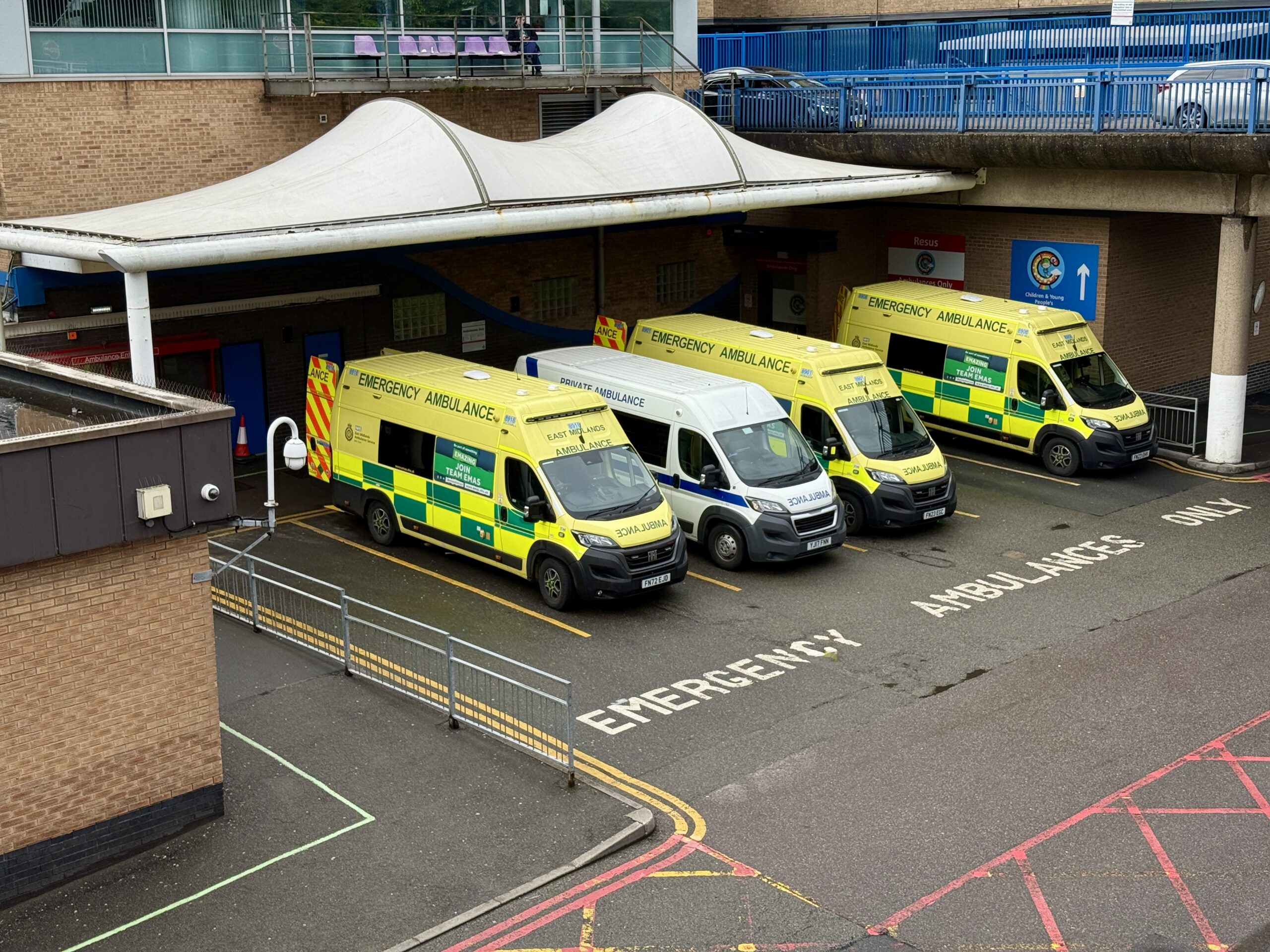
East Midlands Ambulance Service has declared a business continuity incident after sustained pressure on ambulance crews across the region, with demand for emergency care rising during the hot weather and wider NHS services also under strain.
The declaration, made at 7.15pm on Tuesday 26 May, means EMAS can put additional arrangements in place to maintain patient care, including working with hospitals to speed up patient handovers so crews can return to responding to 999 calls. The service has also escalated to REAP Level 4, the highest level in the ambulance service escalation system, which indicates the potential for service failures.


EMAS said it is continuing to prioritise the most life-threatening and serious incidents while reviewing how crews are deployed across the East Midlands. Members of the public are being urged to use 999 only where someone is seriously ill or injured and their life is at risk, and to consider NHS 111, pharmacies, urgent treatment centres, GP services or out-of-hours care for non-life-threatening conditions.
EMAS said:
East Midlands Ambulance Service (EMAS) has declared a business continuity incident (as at 19.15 hours, Tuesday 26 May 2026) following sustained pressure on its services across the region.
In recent days, demand for emergency care has increased, including as a result of the hot weather, alongside wider pressures being experienced across the NHS.
A business continuity incident is declared when services may be disrupted below expected levels and additional arrangements are required to maintain patient care.
Declaring a business continuity incident allows EMAS to take additional steps, working closely with NHS partners, to help ensure ambulance crews are available to respond to patients in the community.
This includes:
Supporting the timely handover of patients at hospital emergency departments, so ambulance crews can return to responding to 999 calls.
Working with healthcare providers to ensure patients are directed to the most appropriate care.
Continuing to prioritise the most life-threatening and serious incidents.
This is to ensure emergency ambulances are available to respond to people in the community where life is at risk.
We recognise this is challenging for our NHS partners, who are also working under significant pressure, and we are grateful for their continued support.
Alongside this, EMAS is maximising available resources and reviewing how ambulance crews are deployed across the region.
We will continue to monitor the situation closely, with a focus on maintaining safe patient care and returning to normal service levels as soon as possible.
Members of the public are asked to support us during this period of high demand.
999 should always be used when someone is seriously ill or injured and their life is at risk.
If your condition is not life-threatening, there are other NHS services available that may be able to help you.
These include:
– NHS 111 online or by phone.
– Local pharmacies.
– Urgent Treatment Centres.
– Your GP (including out-of-hours services).
Choosing the most appropriate service helps ensure our ambulance crews are available for those who may need them most.
Additional information:
1) Given the severity of the concern, senior leaders will continue to respond to the challenges faced and to ensure support for staff and volunteers at work. Therefore, media interviews will not be conducted tonight. Media requests should be sent via communications@emas.nhs.uk and will be responded to tomorrow.
2) In response to pressures in the NHS system and on ambulance services, on Tuesday 26 May 2026, EMAS escalated to Resource Escalation Action Plan (REAP) Level 4 – the highest level which indicates a potential for failures within the service.
3) The Emergency Preparedness Resilience and Response framework describes as business continuity incident as: ‘an event or occurrence that disrupts, or might disrupt, an organisation’s normal service delivery, below acceptable predefined levels, where special arrangements are required to be implemented until services can return to an acceptable level (this could be a surge in demand requiring resources to be temporarily redeployed).
