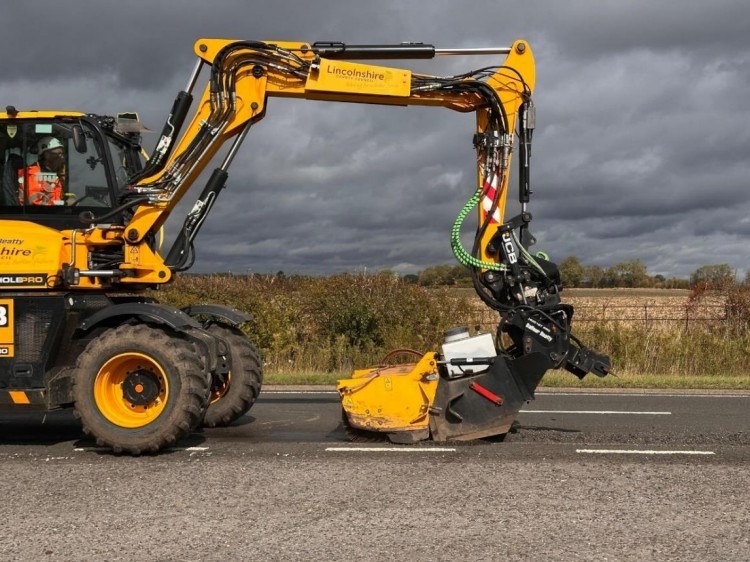
Leicestershire County Council bosses have said an award-winning pothole machine adopted by nearby Reform councils is “too big” and wouldn’t make economical sense to adopt.
The JCB Pothole Pro has been touted as capable of repairing potholes “in just eight minutes”.



The £66,000 machine was adopted by the Reform-run Nottinghamshire County Council, which said that the machine would “help to clear backlogs more quickly and ensure that roads are closed for shorter periods of time” and “reduce repair costs, with permanent, longer-lasting fixes meaning fewer repeat visits”.
Lincolnshire County Council also said its recent adoption of the Pothole Pro was “here to stay” and that it was a “very effective delivery mechanism for repairing roads compared with previous equipment”.
However, highway bosses at Leicestershire County Council (LCC), which is run by Reform, have decided not to take on the award-winning machine because it was “too big” and “inefficient to travel round repairing small potholes”, despite it only being trialled for a day, according to JCB.
According to a Freedom of Information request, highway bosses said the machine “did not stack up as an economical piece of kit to repair potholes in Leicestershire” because it was too slow to fix potholes, required “specialist labour and operators”, as well as providing a “similar output” to what highway bosses are currently using.
The Freedom of Information request reads: “The solution for pothole repairs needs to focus on speed of response and the ability to get on the network with minor traffic management, with minimal impacts from the timescales involved with processing TTROs and permits.

“The quantity of work in most of these locations would also not be adequate to utilise the Pothole Pro’s full potential on a daily basis, which in turn would make it very inefficient.”
Highway bosses also criticised the Pothole Pro and claim that it “struggles to compete” with other vehicles “that are quicker and more efficient” and that “the quality of planning is also better from a dedicated planer”.
The county council also said that, if it did adopt the Pothole Pro, it would need to “invest in more resources” and would only get “a similar output” to what it is using now.
A Leicestershire County Council spokesperson added: “Our main aim is to fill as many potholes as we can, and we’ve invested an extra £2.5m into fixing our roads and recruited more inspectors to assess and fix potholes faster.
“The current machinery we use and how we operate does the job for us, given the size and nature of our road network, and we are confident of how effective it is. However, we’re always open to exploring any new possibilities that may make our work even more efficient for our operation.”
A JCB spokesperson said: “A one-day trial of the JCB Pothole Pro is far too short to evaluate its merits in terms of productivity (the number of potholes filled over a proper timeframe) and quality of repair (how permanent the pothole repairs are).
“The JCB Pothole Pro has proven its worth in other council areas where it has been evaluated more fully, such as Stoke-on-Trent City Council, which has repaired seven years’ worth of potholes in 12 months, a statistic that unequivocally underlines the machine’s efficiency.
“We hope Leicestershire County Council, in light of the recent surge in potholes across the county, will now think differently and undertake a proper, long-term trial and evaluation of the Pothole Pro across its road network.
“Motorists, cyclists and pedestrians in Leicestershire deserve nothing less.”
