
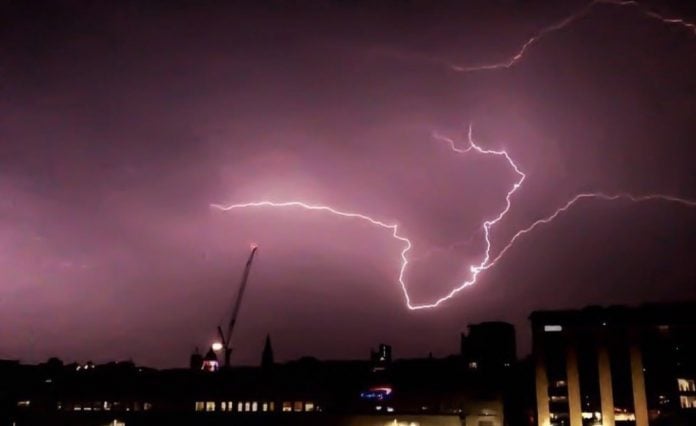
The Met Office says that thunderstorms are expected to hit the UK this week.
Met Office Chief Meteorologist Neil Armstrong said, “A weather system will push northwards through tomorrow, bringing heavy rain and a risk of thunderstorms to parts of southwest England, most of Wales, and later into Northern Ireland. 40mm of rain could fall in 3 hours or less leading to the potential for disruption.
“Further thunderstorms will develop during the afternoon across England and Wales, moving quickly northwards with hail and lightning. Temperatures will remain high, with 26 or 27°C possible again in the north Midlands and parts of north London.
Further rain is expected across western areas early on Friday as a low-pressure system to the west draws in more warm, moist air from the south. A yellow thunderstorm warning has been issued from 3pm Friday to Saturday morning covering parts of the South East and East Anglia.


Deputy Chief Meteorologist Tony Wisson said; “By Friday afternoon and evening, heavy and thundery showers are likely to spread across southeastern England and East Anglia, tracking north-eastwards overnight. There is currently some uncertainty around the exact location and intensity of the thunderstorms, but there is a risk that some areas could see 30 to 50mm of rain, with a risk of even larger accumulations possible.
“With much of the rain falling in a short space of time there is a risk of impacts such as surface water flooding. Frequent lightning, gusty winds and hail could pose additional hazards. Updates to this warning are expected as confidence increases on the exact location of the greatest risk of the heaviest downpours.”
Friday is expected to be the warmest day of the period, with temperatures reaching 28 or 29°C with the chance of 30°C in some isolated spots in eastern areas.
The risk of rain shifts further north into northern England and southern Scotland on Saturday and by Sunday a cooler westerly flow develops. By the start of next week, conditions are expected to become increasingly settled in the south as high pressure builds, with the north likely to remain more changeable.
