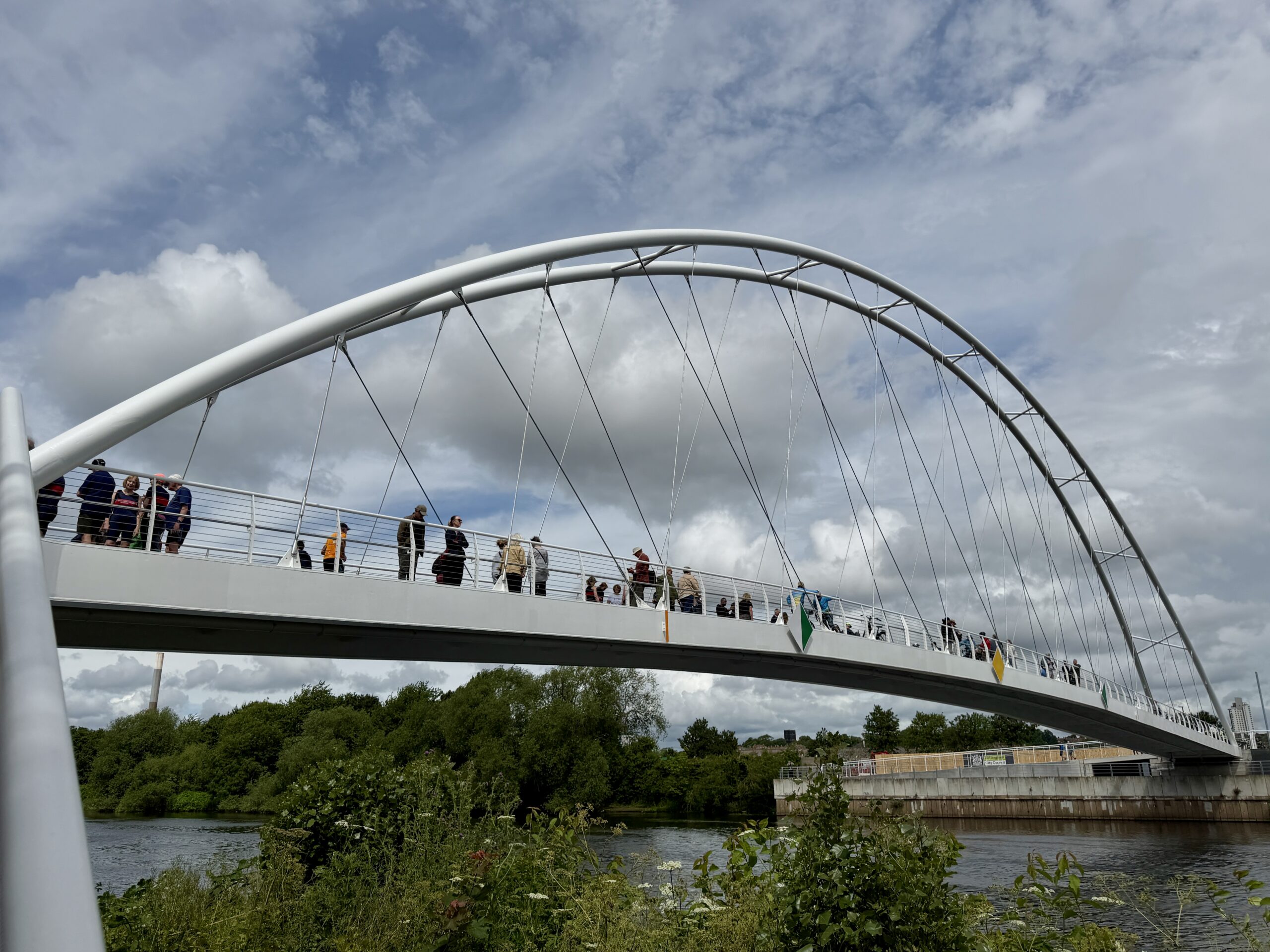
More than 1,400 walking and cycling journeys a day are being recorded on Nottingham’s Waterside Bridge, according to figures released by Nottingham City Council.
An average of 996 walkers and 447 cyclists have used the River Trent crossing each day since it opened on 2 June.


The figures rose to 5,970 walkers and 849 cyclists during the community fun day on 14 June – a combined total of 6,819. Hundreds of people also gathered on the bridge to watch the recent eclipse.
The crossing links Trent Basin with the south bank near The Hook nature reserve in Lady Bay, providing a route between communities on either side of the river and access to Colwick Country Park and nearby sports grounds.
The usage figures come as the council prepares further work on the routes connecting the bridge to the wider walking and cycling network.
This autumn, highways teams will lay tarmac on the temporary route between Waterside Bridge and Poulton Drive, slightly changing its layout.
Further improvements are planned at the roundabout where Daleside Road meets Manvers Street and Meadows Lane, to improve access for pedestrians and cyclists travelling towards the city centre.
The work will include toucan crossings, which can be used by both pedestrians and cyclists, alongside improvements and extensions to footpaths and shared spaces. Existing traffic signal equipment is reaching the end of its life, and the scheme will replace the poles, signal heads and controllers.
Councillor Patience Ifediora, Nottingham City Council’s Executive Member for Regional Development, Growth and Transport, said: “It’s lovely to see Waterside Bridge becoming so incredibly popular in such a short time, both for leisure and for safer, easier journeys locally. It’s a fantastic place to get close to the river and enjoy nature too.”
The bridge opened following several years of planning and development. Nottingham City Council approved the plans in April 2024, with Rushcliffe Borough Council granting approval for its part of the scheme in July that year.
The £18 million project was funded through the government’s Transforming Cities Fund, which supports improvements to sustainable transport. The scheme had originally been expected to cost £9 million.
The 87-metre, 175-tonne tied-arch bridge was built using British steel in Hucknall before being installed at Trent Basin by Balfour Beatty.
Schoolchildren from William Booth Primary School in Sneinton and Lady Bay Primary School joined the opening celebrations on 2 June, crossing the bridge together to mark the new connection.
Thomas said: “I love that the bridge has opened up Colwick Park for me – now I can get to it via the river and it’s a really lovely route. From Colwick, I can essentially get all the way to Barton without touching a road. Roads can be overstimulating – smelly and noisy – so having a quieter space to navigate through the city is really important.”
Sam said: “Thanks to the new bridge, we’re able to cycle to work and leisure safely, which means we’re using less petrol to get around and contributing less pollution and congestion for everyone else. We absolutely love it.”
