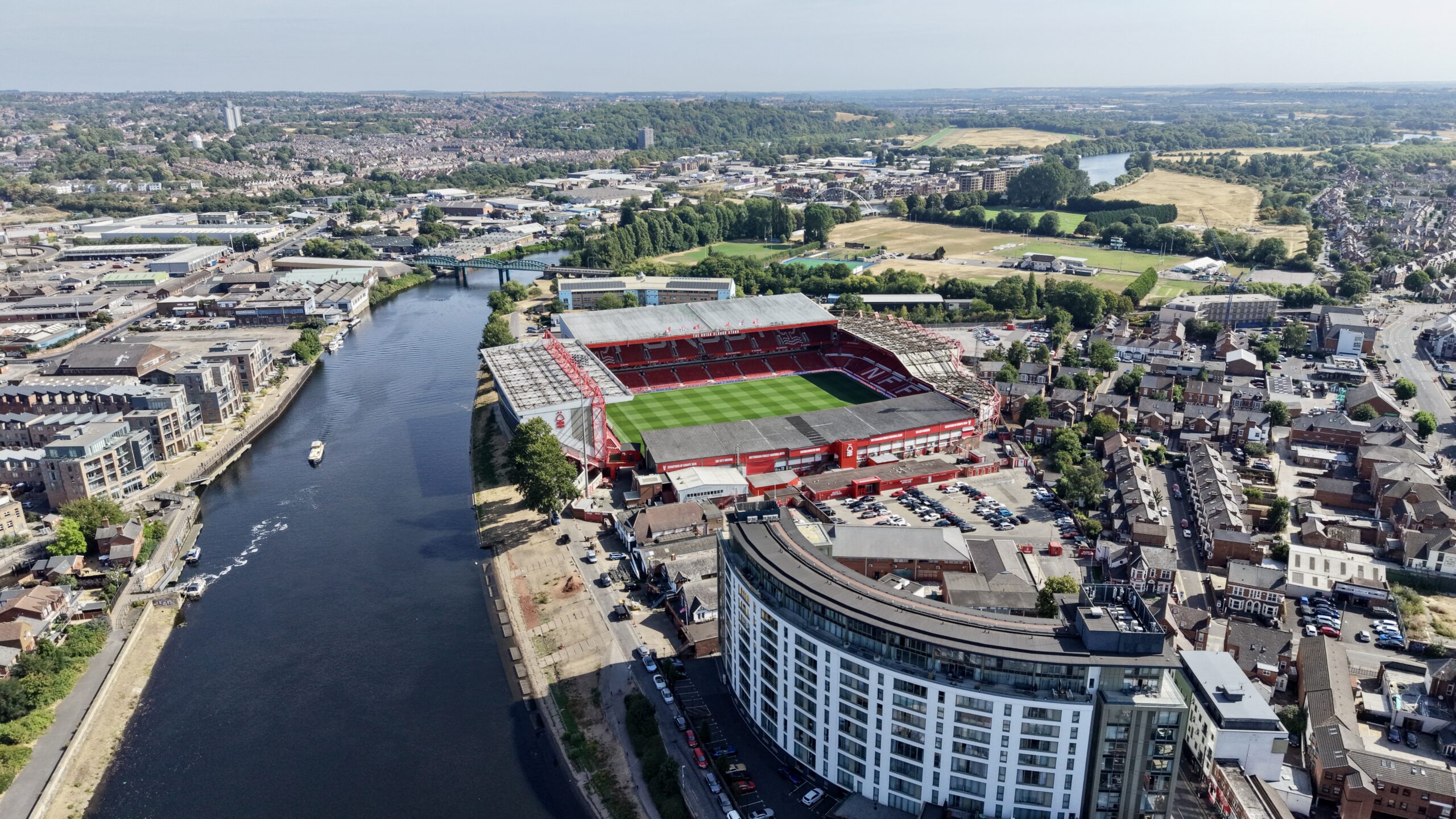
Nottingham Forest could be required to provide a new pedestrian and cycle bridge over the River Trent as part of plans to expand the City Ground to 52,500 seats.
The potential new crossing, which would be built close to the stadium, has been identified by Nottinghamshire County Council and Nottingham City Council as the preferred alternative to permanently removing two traffic lanes from Trent Bridge.


Forest’s current transport proposals would remove one northbound and one southbound lane from Trent Bridge and use the space to widen its footways. The change is intended to accommodate the additional spectators expected to cross the river before and after matches.
However, both councils have said they cannot support the proposed lane closures on the evidence submitted so far because of the potential effects on traffic, buses and the wider road network throughout the year.

A draft Section 106 planning agreement for the stadium development includes an obligation to provide what is described as a River Crossing/Crowd Flow Scheme.
The precise form of that scheme has not been agreed, but the county council says the “most obvious solution” would be a new pedestrian and cycle bridge very close to the City Ground, linking the stadium side of the Trent with the opposite bank.
Nottingham City Council also says a new bridge could address existing pedestrian capacity and safety concerns on Trent Bridge while providing space for the additional supporters generated by the expanded stadium.
The proposed crossing is not currently an approved or funded bridge project. Its width, location, access points and connecting routes would need to be determined through an updated crowd-flow assessment.

The draft legal agreement is also still being considered. Nottinghamshire County Council says it will examine the wording to ensure that a suitable river crossing or crowd-flow scheme would be delivered if the stadium expansion goes ahead.
The issue has arisen because Forest’s latest applications would increase the ground’s capacity in two stages. A full application covering the redevelopment of the Peter Taylor Stand and parts of the Trent End would raise capacity from 30,445 to 45,000, while a separate outline application for the Brian Clough Stand would provide a further 7,500 seats, taking the total to 52,500.
The applications remain under consideration by Rushcliffe Borough Council. The authority has not yet granted permission for the expansion, the Trent Bridge lane changes or a new river crossing.

According to the submitted crowd-flow work, comfortable post-match movement over Trent Bridge would require 12.5 metres of pedestrian space. A width of 11.5 metres could provide free-flowing movement at a higher pedestrian density, but the proposed bridge layout would provide a clear width of 10.4 metres.
That arrangement would also rely on spectators dividing evenly between the two sides of Trent Bridge, which the county council says does not currently happen.
The submitted plans therefore propose managing the shortfall by holding some supporters in queues on Pavilion Road after matches. The county council says previous discussions had indicated that holding departing Forest supporters in this way would not be workable.
Highway officers have also questioned the traffic modelling used to assess the proposed permanent lane reductions. Nottingham City Council says the modelling identifies weekday delays of about 30 seconds per vehicle on several roads near the stadium, with the cumulative effect applying throughout the year rather than only on matchdays.
The city council says reduced capacity could cause queues to extend along London Road and other approaches towards the city centre. It also warns that Trent Bridge would be less able to cope with roadworks, collisions or vehicle breakdowns.
Nottinghamshire County Council says some traffic would be displaced to Lady Bay Bridge and Clifton Bridge. For some journeys, diverting by Clifton Bridge could add approximately four or five miles, but the authority says the additional distance, journey times and environmental effects have not been fully assessed.
Both authorities have also raised concerns about the reliability of the modelling, including the absence of a validated evening peak model and questions over whether planned housing developments in Nottingham, Gedling and Rushcliffe were fully included.
The councils say that if a separate river crossing were secured without removing traffic lanes from Trent Bridge, further modelling of the lane closures would no longer be required.
Other measures proposed alongside a new crossing include additional public transport capacity, matchday shuttle buses, improvements to routes towards Lady Bay Bridge and use of the recently opened Waterside Bridge.
Forest is also proposing to replace the steps leading from the riverside path to Lady Bay Bridge with a six-metre-wide accessible route. The existing three-metre-wide footbridge on that approach would be replaced by a 6.5-metre-wide structure, while footways towards the City Ground would be widened.
Nottinghamshire County Council supports those improvements in principle but says detailed designs have not yet been settled. It wants the work secured through the Section 106 agreement.
Waterside Bridge, which opened in June, already provides a pedestrian and cycle crossing between Trent Basin and the south bank near Lady Bay. However, it is further east than the City Ground and is being treated as one part of a wider package rather than a direct replacement for additional capacity close to the stadium.
A transport working group involving Forest, the city and county councils, Rushcliffe Borough Council, the East Midlands Combined County Authority and transport operators has also been established. Its first meeting was held at the City Ground on 6 August.
Nottinghamshire County Council says it has no objection in principle to increasing the stadium’s capacity, but considers the river crossing issue must be resolved before the development can proceed. Nottingham City Council says it would be able to support the redevelopment if an acceptable alternative crossing and crowd-flow scheme replaced the proposed permanent lane closures.
