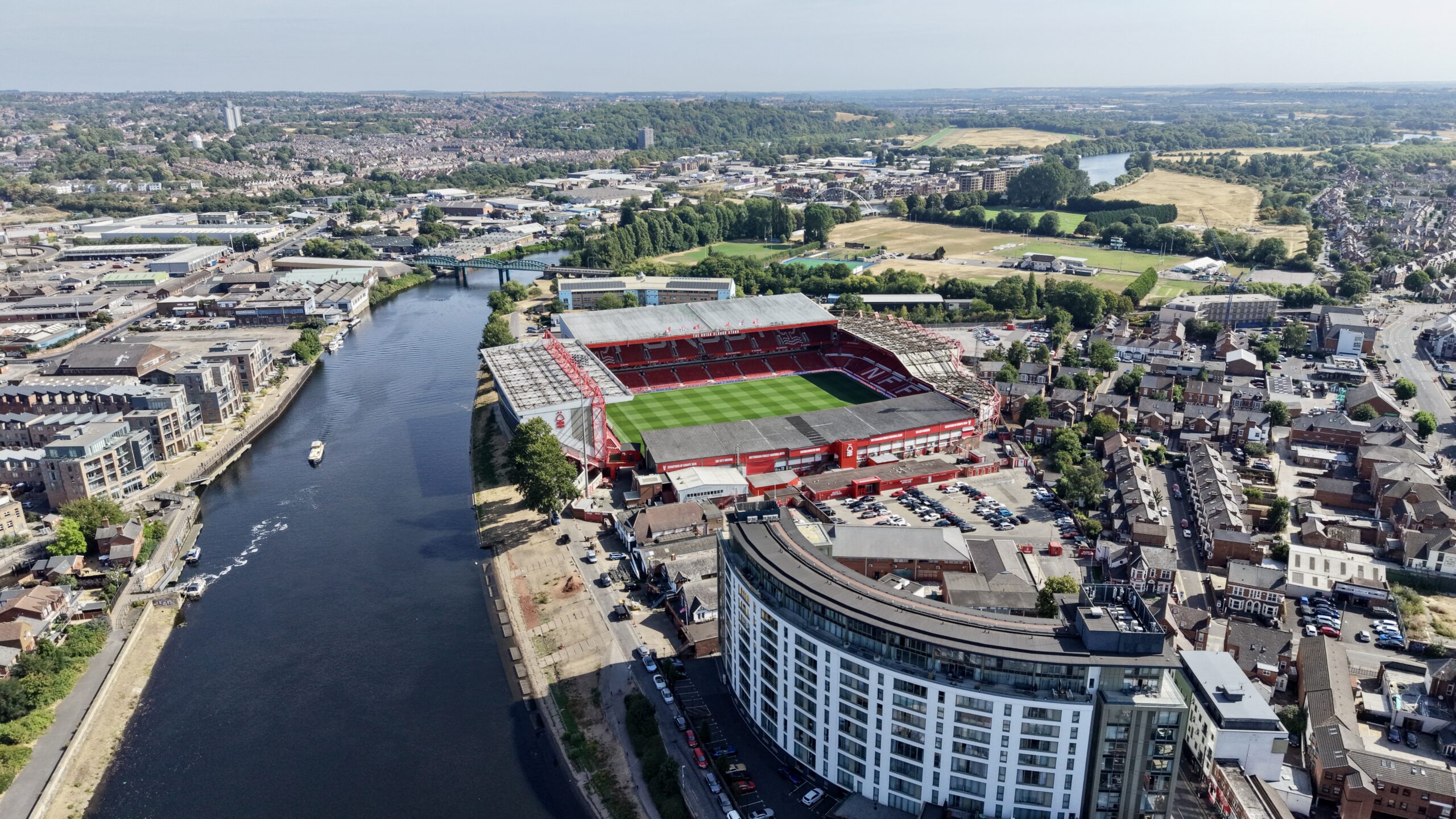
Nottingham Forest’s City Ground expansion must clear further transport and crowd-safety requirements after councillors backed redevelopment plans and added safeguards for neighbouring residents.
Rushcliffe Borough Council’s planning committee voted by 10 votes to one to approve the Peter Taylor Stand and Trent End application on Wednesday 16 September, subject to conditions and completion of a Section 106 legal agreement. Councillor Sue Mallender voted against.


The scheme would increase capacity to around 45,000. During a lengthy debate, councillors questioned how thousands of additional supporters would reach the ground, where they would park and how they would cross the River Trent safely.
Members also secured a requirement for a community liaison group with local representation and brought forward the deadline for works to protect a house adjoining a property due to be demolished.
Planning officers supported the redevelopment because of its economic benefits, improved sporting facilities and new public spaces. However, they made clear that their recommendation depended on securing an acceptable river-crossing and crowd-management solution.
The committee heard that existing footways on Trent Bridge could not accommodate the additional pedestrian demand identified by the club’s consultants.
A proposal to permanently remove two traffic lanes to create more pedestrian space was not supported by either Nottinghamshire County Council or Nottingham City Council as highway authorities. Officers said the loss of road capacity would affect bridge users throughout the year, including bus services on which the stadium’s transport strategy would depend.
A new pedestrian bridge was discussed as a possible alternative, but officers repeatedly stressed that the agreement did not secure a bridge.
Instead, Forest would have to submit an acceptable river-crossing and crowd-flow scheme, supported by an updated assessment, for approval before starting development under the permission.
Preparatory work could then proceed up to slab level, but construction could not move beyond that stage until delivery and funding of the agreed solution had been secured.
The stadium could not operate above the capacity threshold defined in the agreement until the required measures were delivered. Officers explained that there was provision for an approved temporary solution lasting up to 18 months to cover a gap between completion of the stadium works and delivery of the permanent scheme.
Any temporary arrangement would still have to be demonstrated to be safe and acceptable in consultation with the highway authorities.
Officers said Nottingham City Council was undertaking a feasibility study for a possible new pedestrian bridge. Any bridge proposal would require a separate planning application, including consideration of its location and effects on river users.
Much of the debate centred on whether supporters could be persuaded to switch from cars to buses, trams, trains, walking and cycling.
Councillor Steve Calvert said the transport strategy was more developed than the one accompanying the previous stadium application, but questioned whether the forecast changes in travel habits could be achieved.
Councillor Sue Mallender called for free public transport to be included with match tickets, arguing that supporters needed a stronger financial incentive to leave their cars at home. That was a suggestion during the debate, rather than a requirement added to the decision.
Officers acknowledged that the detailed incentives had not yet been settled and would need to form part of an updated travel plan.
They said failure to meet travel targets would trigger further measures, including additional funding for transport mitigation and revisions to the travel plan.
The proposed package includes £1.75 million towards bus services, £990,000 for parking restrictions and approximately £386,000 towards park-and-ride facilities.
The committee heard that the park-and-ride funding was intended to help existing sites operate when required for matches, rather than provide new sites.
A proposed matchday controlled parking zone would cover a wider area than originally envisaged. However, the necessary traffic regulation orders would be subject to their own consultation process.
Officers said the legal agreement would provide for alternative measures if the parking restrictions could not be implemented, although those alternatives had not yet been identified.
Councillors raised concerns about supporters parking just outside the zone and about enforcement against vehicles blocking pavements, driveways and restricted streets.
Councillor Mallender argued that fines alone might not deter some drivers and called for stronger enforcement, including towing vehicles away. Officers said enforcement arrangements would be a matter for the highway authorities.
Members also questioned how residents would influence the transport working group intended to monitor the development’s effects and consider further measures.
Councillor Matt Barney challenged the lack of a guaranteed place for the local ward representative, while Councillor Carys Thomas said transport arrangements mattered both to residents and to supporters’ experience of attending matches.
Following discussion, the committee agreed that the Section 106 agreement should require a community liaison group with local representation, feeding into the transport working group.
The final resolution did not specify individual members of either group.
The impact on neighbouring homes was another focus of the debate.
Officers acknowledged that some properties on the northern side of Rosebery Avenue would experience significant harm through the scale and proximity of the new stand and loss of daylight. They gave that harm limited weight in their assessment because the affected homes were owned by the club.
Councillor Thomas questioned whether the effects on immediate neighbours were being treated as an acceptable consequence of the wider economic benefits.
A Colwick Road resident also requested further daylight assessments, controls over demolition and tree removal, and changes relating to an emergency generator.
Officers said they considered the submitted information sufficient to assess the effects on neighbouring properties. They also explained that separate permission for house demolition remained valid and could not be overridden through conditions on the stadium application.
Committee chair Councillor Rex Walker questioned the proposed timing of work to make good the remaining half of a pair of semi-detached houses after the adjoining property was demolished.
The committee agreed to bring that requirement forward. Treatment of the retained property must be completed before development proceeds beyond slab level, rather than waiting until stadium capacity increases.
The meeting also heard concerns from Nottingham Kayak Club about maintaining vehicle access and access to the river during and after construction.
Officers said conditions covered access arrangements for the boat clubs and their use of the river. They stressed that the effects of any future bridge would have to be considered through a separate application.
Councillors also discussed the loss of the Britannia Boathouse and its historic associations. Councillor Mallender asked about preserving its war memorials, while Councillor Barney said the loss of the building should not be dismissed as insignificant.
Officers said a detailed historic record would be required before demolition, but advised that a condition requiring retention of the memorials would not meet the tests for a planning condition.
In recommending approval, officers concluded that the wider economic and community benefits outweighed the identified harm, provided the transport and crowd-safety safeguards were secured.
The decision therefore allows the redevelopment to move forward, but leaves significant work on legal agreements, transport arrangements and detailed conditions before the expanded capacity can be brought into use.
